MCQ
In a cyclotron, a charged particle
  • Undergoesd acceleration all the time
  • B
    Speeds up between the dees because of the magnetic field
  • C
    Speeds up in a dee
  • D
    Slows down within a dee and speeds up between dees

Answer

Correct option: A.
Undergoesd acceleration all the time
a
The charged particle undergoes acceleration as
$(i)$ Speeds up between the dees because of the oscillating electric field and
$(ii)$ Speed remains the same inside the dees because of the magnetic field but direction undergoes change continuously.

Need a full question paper?

Generate a complete, print-ready paper with questions like this in minutes — across 16+ boards, with answer keys.
Start Generating Free

Similar questions

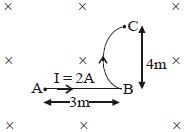
In the given figure force on wire $ABC$ will be $(B = 2T)$
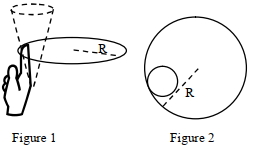
One twirls a circular ring (of mass $M$ and radius $R$ ) near the tip of one's finger as shown in Figure $1$ . In the process the finger never loses contact with the inner rim of the ring. The finger traces out the surface of a cone, shown by the dotted line. The radius of the path traced out by the point where the ring and the finger is in contact is $\mathrm{r}$. The finger rotates with an angular velocity $\omega_0$. The rotating ring rolls without slipping on the outside of a smaller circle described by the point where the ring and the finger is in contact (Figure $2$). The coefficient of friction between the ring and the finger is $\mu$ and the acceleration due to gravity is $g$.

(IMAGE)

($1$) The total kinetic energy of the ring is

$[A]$ $\mathrm{M} \omega_0^2 \mathrm{R}^2$   $[B]$ $\frac{1}{2} \mathrm{M} \omega_0^2(\mathrm{R}-\mathrm{r})^2$   $[C]$ $\mathrm{M \omega}_0^2(\mathrm{R}-\mathrm{r})^2$   $[D]$ $\frac{3}{2} \mathrm{M} \omega_0^2(\mathrm{R}-\mathrm{r})^2$

($2$) The minimum value of $\omega_0$ below which the ring will drop down is

$[A]$ $\sqrt{\frac{g}{\mu(R-r)}}$  $[B]$ $\sqrt{\frac{2 g}{\mu(R-r)}}$  $[C]$ $\sqrt{\frac{3 g}{2 \mu(R-r)}}$    $[D]$ $\sqrt{\frac{g}{2 \mu(R-r)}}$

Givin the answer quetion ($1$) and ($2$)
The e.m.f. of a cell is $E\, volts$ and internal resistance is $r$ $ohm$. The resistance in external circuit is also $r$ $ohm$. The p.d. across the cell will be
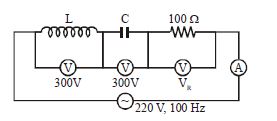
In an $LCR$ circuit shown in the following figure, what will be the readings of the voltmeter across the resistor and ammeter if an a.c. source of $220\ V$ and $100\  Hz$ is connected to it as shown ?
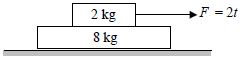
A force $F = Kt$ (where $t$ is the time in seconds and $K = 2\, N/s$) is applied on $2 \,kg$ block at $t = 0$ as shown in the figure. The displacement of $8\ kg$ block till the time when $2\, kg$ block start slipping on $8\,kg$ block will be (coefficient of friction between $2\,kg$ block and $8\, kg$ block is $0.2$ and between $8\, kg$ block and surface is zero,
$g = 10m/s^2)$
A circular plate of uniform thickness has diameter $56\ cm$. A circular part of diameter $42\ cm$ is removed from one edge. What is the position of the centre of mass of the remaining part ........ $cm$.
Critical angle of light passing from glass to air is minimum for which light
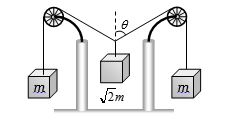
The pulleys and strings shown in the figure are smooth and of negligible mass. For the system to remain in equilibrium, the angle $\theta $should be ........ $^o$
$A$ convex lens forms an image of an object on a screen. The height of the image is $9\, cm$. The lens is now displaced until an image is again obtained on the screen. The height of this image is $4\, cm$. The distance between the object and the screen is $90cm.$
If $1000$ droplets of water of surface tension $0.07\,N / m$. having same radius $1\,mm$ each, combine to from a single drop. In the process the released surface energy is $\left(\text { Take } \pi=\frac{22}{7}\right)$