MCQ
In a cyclotron, a charged particle:
  • Undergoes acceleration all the time.
  • B
    Speeds up between the dees because of the magnetic field.
  • C
    Speeds up in a dee.
  • D
    Slows down within a dee and speeds up between dees.

Answer

Correct option: A.
Undergoes acceleration all the time.
In a cyclotron, a charged particle describes the circular path inside the dees $\&$ is accelerated while going from one dee to another due to the electric field.
While moving in the circular path, charged particles have centripetal acceleration which is provided by the magnetic force due to the magnetic field.
A charged particle undergoes acceleration all the time, inside the cyclotron.

Need a full question paper?

Generate a complete, print-ready paper with questions like this in minutes — across 16+ boards, with answer keys.
Start Generating Free

Similar questions

When the length and area of cross-section both are doubled, then its resistance
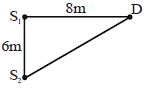
In the figure the intensity of waves arriving at $D$ from two coherent sources $S_1$ and $S_2$ is $2I_0$. The wave length of the wave is $\lambda  = 8\,m$. Resultant intensity at $D$ will be
The incident ray, reflected ray and the outward drawn normal are denoted by the unit vectors $\overrightarrow{ a }, \overrightarrow{ b }$ and $\overrightarrow{ c }$ respectively. Then choose the correct relation for these vectors.
In a cyclotron, the angular frequency of a charged particle is independent of
A diffraction is obtained by using a beam of red light. What will happen if the red light is replaced by the blue light
The $AC$ voltage across a resistance can be measured using a:
The work functions for sodium and copper are $2eV$ and $4eV$. Which of them is suitable for a photocell with $4000 Å$ light
Eddy currents are used in
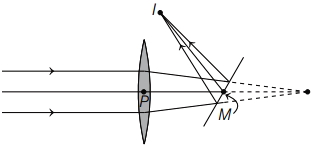
A horizontal parallel beam of light passes through a vertical convex lens of focal length $20 \,cm$ and is then reflected by a tilted plane mirror, so that it converges to a point $I$. The distance $P I$ is $10 \,cm$. $M$ is a point at which the axis of the lens intersects the mirror. The distance $P M$ is $10 \,cm$. The angle which the mirror makes with the horizontal is
The angle of a prism is $A$. One of its refracting surfaces is silvered. Light rays falling at an angle of incidence $2A$ on the first surface returns back through the same path after suffering reflection at the silvered surface. The refractive index $\mu$, of the prism is