Question

In a dc motor, induced e.m.f. will be maximum

(a) When motor takes maximum speed

(b) When motor starts rotating

(c) When speed of motor increases

(d) When motor is switched off

Answer

(a) When motor takes maximum speed

Need a full question paper?

Generate a complete, print-ready paper with questions like this in minutes — across 16+ boards, with answer keys.

Start Generating Free

Similar questions

The wavelength of sodium light in air is 5890 Å. The velocity of light in air is 3  The wavelength of light in a glass of refractive index 1.6 would be close to

(a) 5890 Å

(b) 3681 Å

(c) 9424 Å

(d) 15078 Å

The radius of nuclei of ${ }_{13}^{27} Al$ is ___________.\[\left(R_0=1.2 fm\right)\]

The de-Broglie wavelength of an electron having 80eV of energy is nearly  (1eV = 1.6 × 10⁻¹⁹ J,  Mass of electron = 9 × 10–31kg  Plank’s constant = 6.6 × 10⁻³⁴ J-sec)

(a) 140 Å

(b) 0.14 Å

(c) 14 Å   

(d) 1.4 Å

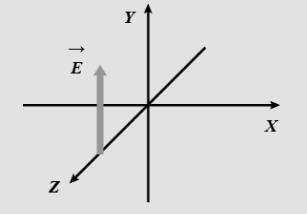
The figure here gives the electric field of an EM wave at a certain poiunt and a certain instrant. the wave is transporting energy in the negative z direction. what is tha direction of the magnetic field of the wave at that point and instant.

A man wishing to get a picture of a Zebra photographed a white donkey after fitting a glass with black streaks onto the objective of his camera.
The SI value of electrical conductivity of free space or vacuum is:
The electrical conductivity of pure germanium can be increased by:
An electromagnetic wave, going through vacuum is described by $\text{E}=\text{E}_0\sin(\text{kx}-\omega\text{t}.)$ Which of the following is independent of wavelength?

A person can see clearly only upto a distance of 25 cm. He wants to read a book placed at a distance of 50 cm. What kind of lens does he require for his spectacles and what must be its power

(a)  Concave, – 1.0 D

(b)  Convex,  + 1.5 D

(c)  Concave, – 2.0 D

(d)  Convex, + 2.0 D

Assertion  :   Torque on the coil is the maximum, when coil is suspended in a radial magnetic field.

Reason      : The torque tends to rotate the coil on its own axis.

(a) If both assertion and reason are true and the reason is the correct explanation of the assertion.

(b) If both assertion and reason are true but reason is not the correct explanation of the assertion.

(c) If assertion is true but reason is false.

(d) If the assertion and reason both are false.