In a circuit shown in the figure, the capacitor $C$ is initially uncharged and the key $K$ is open. In this condition, a current of $1 \mathrm{~A}$ flows through the $1 \Omega$ resistor. The key is closed at time $t=t_0$. Which of the following statement($s$) is(are) correct?
[Given: $\mathrm{e}^{-1}=0.36$ ]
($A$) The value of the resistance $R$ is $3 \Omega$.
($B$) For $t$
($C$) At $t=t_0+7.2 \mu \mathrm{s}$, the current in the capacitor is $0.6 \mathrm{~A}$.
($D$) For $t \rightarrow \infty$, the charge on the capacitor is $12 \mu C$.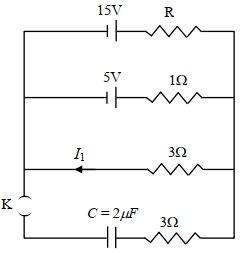
IIT 2023, Medium
Download our app for free and get started
(image)
By writing voltage drop across $1 \Omega$
$\Rightarrow 0+5+1 \times 1=\mathrm{V}$
$\quad \mathrm{V}=6$
$\Rightarrow \text { Similarly across } \mathrm{R}$
$0+15-\mathrm{I} \times \mathrm{R}=6$
$\mathrm{IR}=9$
$\Rightarrow \text { across } 3 \Omega$
$\quad 6-3 \mathrm{I}_1=0$
$\mathrm{I}_1=2 \mathrm{~A}$
Hence option $(B)$ is correct
$\Rightarrow \quad \mathrm{I}=1+2$
$\mathrm{I}=3$
$\mathrm{IR}=9$
$\mathrm{R}=3 \Omega$
Option $(A)$ is correct
(image)
$\varepsilon=\frac{\frac{15}{3}+\frac{5}{1}+\frac{0}{3}}{\frac{1}{3}+\frac{1}{1}+\frac{1}{3}}=10 \times \frac{3}{5}=6 \mathrm{~V}$
$\mathrm{q}_{\max }=2 \times 6=12 \mu \mathrm{C}$
$\mathrm{i}=\frac{6}{3.6} \mathrm{e}^{-\frac{\mathrm{t}}{\tau}}$
$=\frac{5}{3} \mathrm{e}-\frac{7.2}{7.2}=\frac{5}{3} \mathrm{e}^{-1} \approx 0.6 \mathrm{~A}$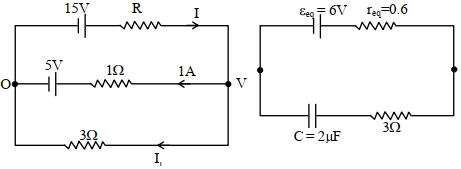

Download our appand get started for free
Experience the future of education. Simply download our apps or reach out to us for more information. Let's shape the future of learning together!No signup needed.*
Similar Questions
- 1In a meter bridge experiment the balance point in obtained if the gaps are closed by $2\,\Omega$ and $3\,\Omega$. A shunt of $x\,\Omega$ is added to $3\,\Omega$ resistor to shift the balancing point by $22.5\,cm$. The value of $X$ is $................$View Solution
- 2What is the number density of donor atoms which must be added to a pure germanium semiconductor to make $n-$ type semiconductor of conductivity $6.4\ {\Omega ^{ - 1}}\,c{m^{ - 1}}$? The mobility of electr ons in $n-$ type germanium is $4 \times {10^3}\ cm^2\ V^{-1}\ s^{-1}$. Neglect the contribution of holes to conductivityView Solution
- 3Resistors of $1$, $2$, $ohm$ are connected in the form of a triangle. If a $1.5\, volt$ cell of negligible internal resistance is connected across $3\, ohm$ resistor, the current flowing through this resistance will be ................ $amp$View Solution
- 4View SolutionAll of the following statements are true except
- 5View SolutionThe material of wire of potentiometer is
- 6For a cylinder of radius $R$ current density $J =J_0 \frac{r}{R} $, where $J_0$ is a constant and $r$ is distance from axis. Calculate total currentView Solution
- 7Two bulbs consume same power when operated at $200\, V$ and $300\, V$ respectively. When these bulbs are connected in series across a $D.C$. source of $500\, V$, thenView Solution
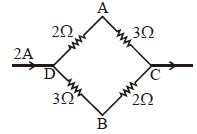
- 8A current of $2\, A$ flows in a system of conductors as shown. The potential difference $(V_A -V_B)$ will be ................ $\mathrm{V}$View Solution
- 9When a current $I$ is passed through a wire of constant resistance, it produces a potential difference $V$ across its ends. The graph drawn between $\log\, I$ and $\log\, V$ will beView Solution
- 10A current of $1.6\, A$ is flowing through a wire having cross-sectional area $1\, mm^2$. If density of free electrons in the material of the wire is $10^{29}\, per\, m^3$, the drift velocity of electrons will beView Solution