MCQ
In a diatomic molecule, the rotational energy at a given temperature.
  • A
    Obeys Maxwell’s distribution.
  • B
    Have the same value for all molecules.
  • C
    Equals the translational kinetic energy for each molecule.
  • D
    Is (2/3)rd the translational kinetic energy for each molecule.

Answer

  1. Obeys Maxwell’s distribution.
  1. Is (2/3)rd the translational kinetic energy for each molecule.

Explanation:

Consider a diatomic molecule along z-axis so its rotational energy about z-axis is zero. So energy of diatomic molecule,

$\text{E}=\frac{1}{2}\text{mv}_\text{x}^2+\frac{1}{2}\text{mv}_\text{y}^2+\frac{1}{2}\text{mv}_\text{z}^2+\frac{1}{2}\text{I}_\text{x}\omega_\text{x}^2+\frac{1}{2}\text{I}_\text{y}\omega_\text{y}^2$ (as moment of inertia along z axis is zero)
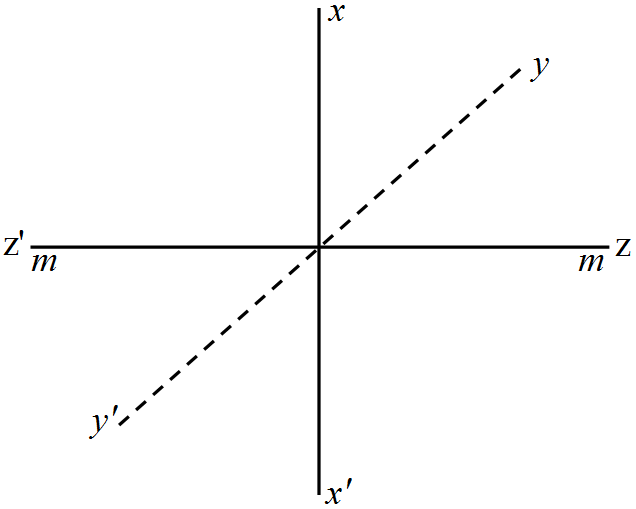
The independent terms in the above expression is 5.

As we can predict velocities of molecules by Maxwell’s distribution.

Hence the above expression also obeys Maxwell’s distribution.

As 2 rotational and 3 translational energies are associated with each molecule.

So the rotational energy at given temperature is 2/3 of its translational Kinetic energy of each molecule.
Need a full question paper?

Generate a complete, print-ready paper with questions like this in minutes — across 16+ boards, with answer keys.

Start Generating Free

Similar questions

$300$ Joule of work is done in sliding up a $2 \,kg$ block on an inclined plane to a height of $10\, metres$. Taking value of acceleration due to gravity $‘g’ $ to be $10 \,m/s^2$, work done against friction is ........ $J$
In one average-life:
  1. Half the active nuclei decay.
  2. Less than half the active nuclei decay.
  3. More than half the active nuclei decay.
  4. All the nuclei decay.
The angle made by the vector $\left( {\hat i\,\, + \;\,\hat j} \right)$ with $x-$ axis and $y$ axis is
A man standing on a road hold his umbrella at $30^° $ with the vertical to keep the rain away. He throws the umbrella and starts running at $10\, km/hr$. He finds that raindrops are hitting his head vertically, the speed of raindrops w.r.t. the moving man, will be
An open pipe is in resonance in its $2^{nd}$ harmonic with tuning fork of frequency ${f_1}$. Now it is closed at one end. If the frequency of the tuning fork is increased slowly from ${f_1}$ then again a resonance is obtained with a frequency ${f_2}$. If in this case the pipe vibrates ${n^{th}}$ harmonics then
Pressure at the bottom of a tank of water is $3P$, where $P$ is atmospheric pressure. If water is drawn out till the level of water is lowered by one fifth, then the pressure at the bottom of the tank is
A stone weighing $1$ kg and sliding on ice with a velocity of $2$ m/s is stopped by friction in $10$ sec. The force of friction (assuming it to be constant) will be ......... $N$
In a experiment to measure the height of a bridge by dropping a stone into water underneath, if the error in the measurement of times is $0.1\;s$ at the end of $2\;s$, then the error in the estimation of the height of the bridge will be
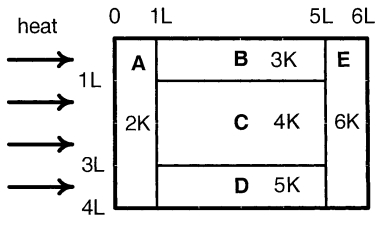
A composite block is made of slabs $A, B, C, D$ and $E$ of different thermal conductivities (given in terms of a constant $K$ ) and sizes (given in terms of length, $L$ ) as shown in the figure. All slabs are of same width. Heat $'Q'$ flows only from left to right through the blocks. Then in steady state $Image$

$(A)$ heat flow through $A$ and $E$ slabs are same.

$(B)$ heat flow through slab $E$ is maximum.

$(C)$ temperature difference across slab $E$ is smallest.

$(D)$ heat flow through $C =$ heat flow through $B +$ heat flow through $D$.

A cylindrical tank has a hole of $1 cm^2$ in its bottom. If the water is allowed to flow into the tank from a tube above it at the rate of $70 cm^3/sec$. then the maximum height up to which water can rise in the tank is  .......... $cm$