MCQ
In a diatomic molecules, the rotational energy at a given temperature:
  • A
    Obeys Maxwell’s distribution
  • B
    Have the same volue for all molecules
  • C
    Equals the translational kinetic energy for each molecule
  • D
    None of these

Answer

  1. Obeys Maxwell’s distribution

Need a full question paper?

Generate a complete, print-ready paper with questions like this in minutes — across 16+ boards, with answer keys.
Start Generating Free

Similar questions

What kind of motion is rectilinear motion?
If $x=5 \sin \left(\pi t+\frac{\pi}{3}\right) \mathrm{m}$ represents the motion of a particle executing simple harmonic motion, the amplitude and time period of motion, respectively, are
If the size of bacteria is 1u, then the number of bacteria in 1m length will be:
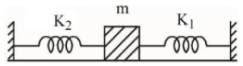
A mass $m$ is attached to two springs as shown in figure. The spring constants of two springs are $K _1$ and $K _2$. For the frictionless surface, the time period of oscillation of mass $m$ is
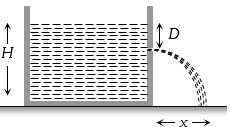
A tank is filled with water up to a height $H$. Water is allowed to come out of a hole $ P$  in one of the walls at a depth $ D $ below the surface of water. Express the horizontal distance $x$  in terms of $ H $ and $D$ 
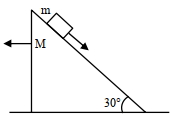
A block of mass $m$ slides on the wooden wedge, which in turn slides backward on the horizontal surface. The acceleration of the block with respect to the wedge is : Given ${m}=8 \,{kg}, {M}=16\, {kg}$

Assume all the surfaces shown in the figure to be frictionless.
A ball is projected horizontally with a speed $v$ from the top of inclined an plane which is  inclined at an angle $45^o$ with the horizontal. How far from the point of projection will  the ball strike the plane ?
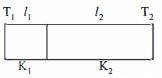
One end of a thermally insulated rod is kept at a temperature $T_1$ and the other at $T_2$ . The rod is composed of two sections of length $l_1$ and $l_2$ and thermal conductivities $K_1$ and $K_2$ respectively. The temperature at the interface of the two section is
If the source of light used in a Young's double slit experiment is changed from red to violet:
  1. The fringes will become brighter.
  2. Consecutive fringes will come closer.
  3. The intensity of minima will increase.
  4. The central bright fringe will become a dark fringe.
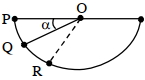
A ball is released from rest from point $P$ of a smooth semi-spherical vessel as shown in figure. The ratio of the centripetal force and normal reaction on the ball at point $Q$ is $A$ while angular position of point $Q$ is $\alpha$ with respect to point $P$. Which of the following graphs represent the correct relation between $A$ and $\alpha$ when ball goes from $Q$ to $R$ ?