Question
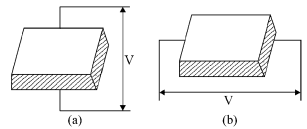
In a given figure, a rectangular object is shown. Its length is I, breadth is 0.5 I and thickness 0.25 I . To measure its resistance, potential difference $V$ is applied in two ways [figure (a) and (b)]. In which arrangement, the resistance of the substance will be more?
Image

Answer

If resistance in both states is $R_1$ and $R_2$
By definition of resistance,$R =\rho \frac{l}{A}$
$R _1=\frac{\rho(0.25 l)}{(l)(0.5 l)}=\frac{\rho}{2 l}$
and $R _2=\frac{(\rho)(l)}{(0.5 l)(0.25 l)}=\frac{8 \rho}{l}$
i.e. $\quad R _2> R _1$
Although the resistance of substance does not depend on potential difference and current but depends on the area of the cross section from which current enters.

Need a full question paper?

Generate a complete, print-ready paper with questions like this in minutes — across 16+ boards, with answer keys.

Start Generating Free

Similar questions

A molecule of a substance has a permanent electric dipole moment of magnitude $10^{-29} C m$. A mole of this substance is polarised (at low temperature) by applying a strong electrostatic field of magnitude $10^6 V m ^{-1}$. The direction of the field is suddenly changed by an angle of $60^{\circ}$. Estimate the heat released by the substance in aligning its dipoles along the new direction of the field. For simplicity, assume $100 \%$ polarisation of the sample.
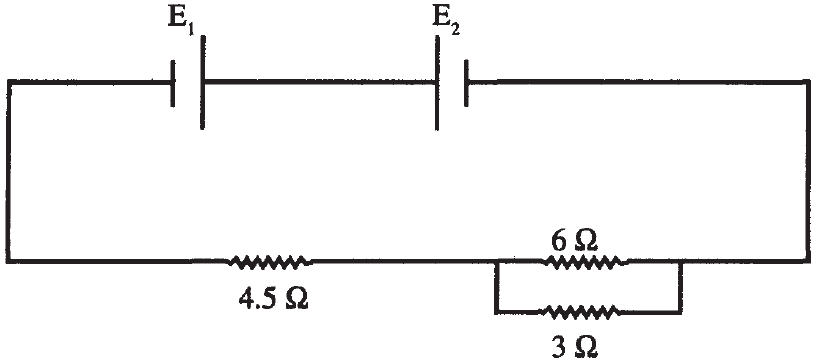
Two cells $E_1$ and $E_2$ in the given circuit diagram have an emf of $5 V$ and $9 V$ and internal resistance of $0.3 \Omega$ and $1.2 \Omega$ respectively.
Calculate the value of current flowing through the resistance of $3 \Omega$.
Derive an expression for (i) induced emf and (ii) induced current when a conductor of length l is moved with a uniform velocity, normal to a uniform magnetic field B. Assume the resistance of conductor to be R.
State and explain Lenz's law
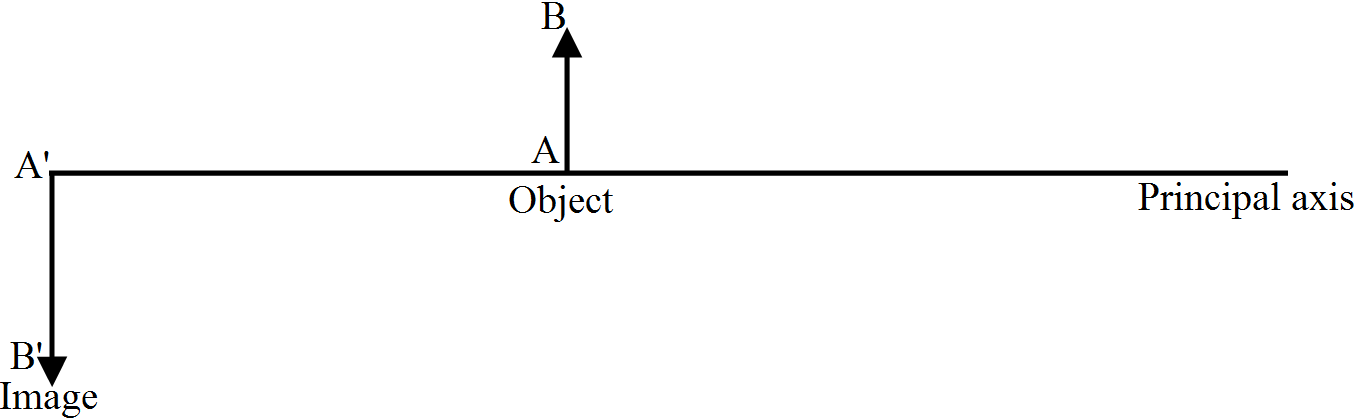
Redraw the diagram given below and mark the position of the centre of curvature of the spherical mirror used in the given set up.
Why are infrared waves often called heat waves ? Explain.
  1. Write the necessary conditions for the phenomenon of total internal reflection to occur.
  2. Write the relation between the refractive index and critical angle for a given pair of optical media.
Two point charges $4Q, Q$ are separated by $1\ m$ in air. At what point on the line joining the charges is the electric field intensity zero?
Also calculate the electrostatic potential energy of the system of charges, taking the value of charge, $Q = 2 \times 10^{–7} C.$
Calculate the potential energy of a single charge in an external field.
Describe experiment of two coils explaining electromagnetic induction.