MCQ
In a gravitational field, at a point where the gravitational potential is zero
  • The gravitational field is necessarily zero
  • B
    The gravitational field is not necessarily zero
  • C
    Nothing can be said definitely about the gravitational field
  • D
    None of these

Answer

Correct option: A.
The gravitational field is necessarily zero
a
(a) $I = \frac{{ - dV}}{{dx}}$ 

If $V = 0$ then gravitational field is necessarily zero.  

Need a full question paper?

Generate a complete, print-ready paper with questions like this in minutes — across 16+ boards, with answer keys.

Start Generating Free

Similar questions

Solid targets of different elements are bombarded by highly energetic electron beams. The frequency $(f)$ of the characteristic $X-$ rays emitted from different targets varies with atomic number $Z$ as
The distance covered by a particle undergoing $SHM$ in one time period is (amplitude $= A$)
A plane electromagnetic wave of frequency $100\, MHz$ is travelling in vacuum along the $x -$ direction. At a particular point in space and time, $\overrightarrow{ B }=2.0 \times 10^{-8} \hat{ k } T$. (where, $\hat{ k }$ is unit vector along $z-$direction) What is $\overrightarrow{ E }$ at this point ?
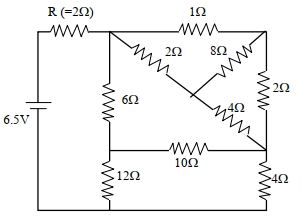
In the following circuit, the current through the resistor $R(=2 \Omega)$ is $I$ Amperes. The value of $I$ is
In which of the following is the interference due to the division of wave front
A air bubble of radius $1\,cm$ in water has an upward acceleration $9.8\, cm\, s ^{-2}$. The density of water is $1\, gm\, cm ^{-3}$ and water offers negligible drag force on the bubble. The mass of the bubble is$.......gm$

$\left( g =980 \,cm / s ^{2}\right)$

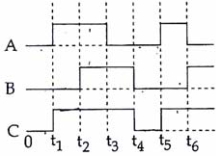
The figure shows a logic circuit with two inputs $A$ and $B$ and the output $C.$ The voltage wave forms across $A, B$ and $C$ are as given. The logic circuit gate is
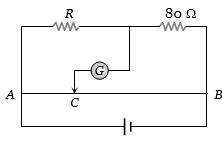
$AB$ is a wire of uniform resistance. The galvanometer $G$ shows no current when the length $AC = 20\,cm$ and $CB = 80\, cm$. The resistance $R$ is equal to .............. $\Omega $
The angle of incidence at which reflected light is totally polarized for reflection from air to glass (refractive index n), is
When an air bubble rises from the bottom of a deep lake to a point just below the water surface, the pressure of air inside the bubble