Question
In a head-on collision between two particles, is it necessary that the particles will acquire a common velocity at least for one instant?

Answer

It is not necessary that in a head on collision the particles would acquire same initial velocity it is possible in elastic collision but it is not necessary.

Need a full question paper?

Generate a complete, print-ready paper with questions like this in minutes — across 16+ boards, with answer keys.
Start Generating Free

Similar questions

The temperature of the surface of the sun is about 6000K. Can we produce a temp. of 7000K by converging the sun's rays using a large convex lens?
Draw the graph showing the variation of potential energy and kinetic energy of a block attached to a spring, which obeys Hooke's law.
Explain why Water on a clean glass surface tends to spread out while mercury on the same surface tends to form drops. (Put differently, water wets glass while mercury does not.)
The radius of atom is of the order of $2\mathring{\text{A}}$ and radius of a nucleus is of the order of fermi. How many magnitudes higher is the volume of atom as compared to the volume of nucleus?
The period of simple harmonic motion of a body suspended from a spring is cut the spring into two equal parts.
(a) Hang the same body from one spring and make it oscillate, then find the time period.
(b) What will be the period of oscillation if both the pieces are connected in parallel and oscillated?
Although velocity of air molecules is very fast but fragnance of a perfume spreads at a much slower rate, explain?
The speed of sound in a solid is given by the formula: $\text{v}=\sqrt{\frac{\text{E}}{\rho}}$ Where, E is coefficient of elasticity and pis density of given solid. Check the relation by method of dimensional analysis.
A cylinder of fixed capacity 44.8 litres contains helium gas at standard temperature and pressure. What is the amount of heat needed to raise the temperature of the gas in the cylinder by $15.0^{\circ} C ?\left(R=8.31 J mol ^{-1} K ^{-1}\right)$.
The gravitational field in a region is given by $\overrightarrow{\text{E}}=(5\text{N/kg})\overrightarrow{\text{i}}+(12\text{N/kg})\overrightarrow{\text{j}}.$
  1. Find the magnitude of the gravitational force acting on a particle of mass $2\ kg$ placed at the origin.
  2. Find the potential at the points $(12m, 0)$ and $(0, 5m)$ if the potential at the origin is taken to be zero.
  3. Find the change in gravitational potential energy if a particle of mass $2\ kg$ is taken from the origin to the point $(12m, 5m)$.
  4. Find the change in potential energy if the particle is taken from $(12m, 0)$ to $(0, 5m)$.
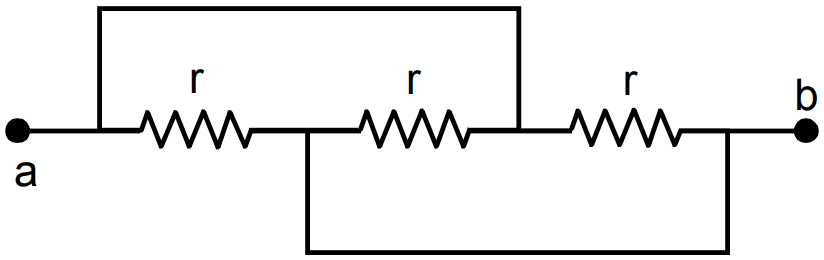
Find the equivalent resistance of the network shown in figure. between the points a and b.