MCQ
In a p-n junction:
  • A
    New holes and conduction electrons are produced continuously throughout the material.
  • B
    New holes and conduction electrons are produced continuously throughout the material except in the depletion region.
  • Holes and conduction electrons recombine continuously throughout the material except in the depletion region.
  • D
    A and C both.

Answer

Correct option: C.
Holes and conduction electrons recombine continuously throughout the material except in the depletion region.
Explanation:
In a p‒n junction diode, diffusion current flows because of the diffusion of holes from the p side to the n side and of electrons from the n side to the p side. The current flowing in the diode due to the diffusion of charge carriers across the junction is called the diffusion current. The current flowing in the diode due to the movement of minority carriers across the junction due to their thermal energy is called the drift current. In an unbiased diode, the net current flowing across the junction is zero due to the cancellation of the drift current by the diffusion current. For the flow of diffusion and drift currents, holes and electrons are produced continuously throughout the material. When a hole crosses the junction, it combines with an electron on the n side. As the depletion region is devoid of free charge carriers, this recombination never takes place inside the depletion region.
Need a full question paper?

Generate a complete, print-ready paper with questions like this in minutes — across 16+ boards, with answer keys.

Start Generating Free

Similar questions

Two heater wires of equal length are first connected in series and then in parallel. The ratio of heat produced in the two cases is
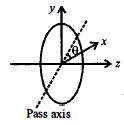
A plane polarized light is incident on a polariser with its pass axis making angle $\theta$ with $x-$ axis, as shown in the figure. At four different values of $\theta$, $\theta\, = 8^o, 38^o, 188^o$ and $218^o$, the observed intensities are same. What is the angle between the direction of polarization and $x-$ axis.....$^o$
When the convergent nature of a convex lens will be less as compared with air
An atomic nucleus ${90^{Th}}^{232}$ emits several a and b radiations and finally reduces to ${82^{Pb}}^{208}$. It must have emitted
The range of wavelength of the visible light is
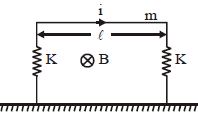
A horizontal metallic rod of mass $'m'$ and length $'l'$ is supported by two vertical identical springs of spring of spring constant $'K'$ each and natural length $l_0.$  A current $'i'$ is flowing in the rod in the direction shown. If the rod is in equilibrium then the length of each spring in this state is :-
If a coil of $40$ turns and area $4.0\, cm^2$ is suddenly removed from a magnetic field, it is observed that a charge of $2.0 \times {10^{ - 4}}\,C$ flows into the coil. If the resistance of the coil is $80\Omega $, the magnetic flux density in $Wb/{m^2}$ is
What is the electric field in the cavity of a hollow charged conductor?
The dominant mechanisms for motion of charge carriers in forward and reverse biased silicon $P-N$ junctions are
Two concentric circular coils of ten turns each are situated in the same plane. Their radii are 20 and 40 cm and they carry respectively 0.2 and 0.3 ampere current in opposite direction. The magnetic field in weber/m$^2$ at the centre is