MCQ
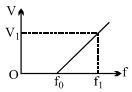
In a photoelectric experiment, the potential difference $V$ that must be maintained between the illuminated surface and the collector so as just to prevent any electron from reaching the collector is determined for different frequencies $f$ of the incident illumination. The graph obtained is shown. The maximum kinetic energy of the electrons emitted at frequency $f_1$ is 
  • A
    $hf_1$
  • B
    $\frac{{{V_1}}}{{({f_1} - {f_0})}}$
  • $h (f_1 - f_0)$
  • D
    $eV_1(f_1 - f_0)$

Answer

Correct option: C.
$h (f_1 - f_0)$
c

Need a full question paper?

Generate a complete, print-ready paper with questions like this in minutes — across 16+ boards, with answer keys.

Start Generating Free

Similar questions

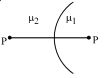
Two refracting media are separated by a spherical interface as shown in the figure. $PP’$ is the principal axis, $\mu_1$ and $\mu_2$ are the refractive indices of medium of incidence and medium of refraction respectively. Then :
Assertion : Corpuscular theory fails in explaining the velocities of light in air and water.
Reason : According to corpuscular theory, light should travel faster in denser medium than, in rarer medium.
A small bar magnet has a magnetic moment $1.2 \,A-m^2$. The magnetic field at a distance $ 0.1\, m $ on its axis will be : ($\mu_0 = 4\pi \times 10^{-7} \,T-m/A$)
In hydrogen atom, if transition of electron from third orbit to second orbit, then wavelength of emitted radiation will be :
A flat circular disc has a charge $ + Q$ uniformly distributed on the disc. A charge $ + q$ is thrown with kinetic energy $E$ towards the disc along its normal axis. The charge $q$ will
In a photoelectric experiment the stopping potential for the incident light of wavelength $4000\mathring{\text{A}}$ is $2$ volt. If the wavelength be changed to $3000\mathring{\text{A}}$, the stopping potential will be?
Three resistors each of 4Ω are connected together to form a network. The equivalent resistance of the network cannot be
Metals getting magnetised by orientation of atomic magnetic moments in external magnetic field are called:
The minimum distance between an object and its real image formed by a convex lens is
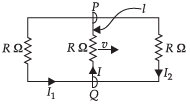
A rectangular loop has a sliding connector $PQ$ of length $l$ and resistance $R\ \Omega$ and it is moving with a speed $v$ as shown. The set-up is placed in a uniform magnetic field going into the plane of the paper. The three currents $I_1 , I_2$ and $I$ are