MCQ
In a projectile motion the velocity:
  • A
    Is always perpendicular to the acceleration.
  • B
    Is never perpendicular to the acceleration.
  • Is perpendicular to the acceleration for one instant only.
  • D
    Is perpendicular to the acceleration for two instants.
Answer

Correct option: C.
Is perpendicular to the acceleration for one instant only.
Explanation:

In projectile motion, velocity is perpendicular to acceleration only at the highest point. Here, velocity is along the horizontal direction and acceleration is along the vertically downward direction.

Need a full question paper?

Generate a complete, print-ready paper with questions like this in minutes — across 16+ boards, with answer keys.

Start Generating Free

Similar questions

The term on the $\text{RHS}$ of the Gauss’s law shows the:
An initially parallel cylindrical beam travels in a medium of refractive index $\mu(I) = \mu_0 + \mu_2I $ where $μ_0$ and $μ_2$ are positive constants and $I$ is the intensity of the light beam. The intensity of the beam is decreasing with increasing radius.

As the beam enters the medium , it will

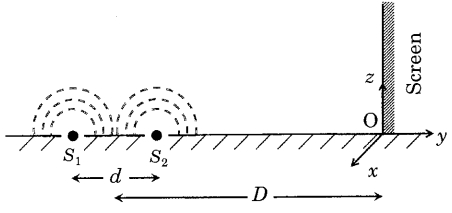
While conducting the Young's double slit experiment, a student replaced the two slits with a large opaque plate in the $x-y$ plane containing two small holes that act as two coherent point sources $\left(S_1, S_2\right)$ emitting light of wavelength $600 \mathrm{~nm}$. The student mistakenly placed the screen parallel to the $x-z$ plane (for $z>0$ ) at a distance $D=3 \mathrm{~m}$ from the mid-point of $S_1 S_2$, as shown schematically in the figure. The distance between the sources $d=0.6003 \mathrm{~mm}$. The origin $\mathrm{O}$ is at the intersection of the screen and the line joining $S_1 S_2$. Which of the following is(are) true of the intensity pattern on the screen?

($A$) Straight bright and dark bands parallel to the $x$-axis

($B$) The region very close to the point $O$ will be dark

($C$) Hyperbolic bright and dark bands with foci symmetrically placed about $\mathrm{O}$ in the $x$-direction

($D$) Semi circular bright and dark bands centered at point $\mathrm{O}$

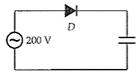
In the circuit given in the figure, an a.c. source of 200 V is connected through a diode D to a capacitor. The potential difference across the capacitor will be

Image
The equation of an alternating voltage is $E = 220 E = 220$.Then the impedance of the circuit is:
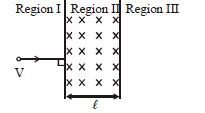
A particle of mass $m$ and charge $q$ , moving with velocity $V$ enters region $II$ normal to the boundary as shown in the figure. Region $II$ has a uniform magnetic field $B$ perpendicular to the plane of the paper. The length of the region $II$ is $l$ . Choose the not correct choice
n identical bulbs, each designed to draw a power p from a certain voltage supply, are joined in series across that supply. The total power which they will draw is
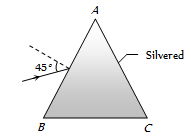
A prism ABC of angle 30° has its face AC silvered. A ray of light incident at an angle of 45° at the face AB retraces its path after refraction at face AB and reflection at face AC. The refractive index of the material of the prism is
The time period of rotation of the sun is 25 days and its radius is $7\times 10^8$ m. The Doppler shift for the light of wavelength 6000 Å emitted from the surface of the sun will be
A point source of light is placed at a distance, of 2f from a converging lens of focal length f. The intensity on the other side of the lens is maximum at a distance: