Question
In a Quincke's experiment, the sound intensity has a minimum value I at a particular position. As the sliding tube is pulled out by a distance of 16.5mm, the intensity increases to a maximum of 9I. Take the speed of sound in air to be 330m/s.
  1. Find the frequency of the sound source.
  2. Find the ratio of the amplitudes of the two waves arriving at the detector assuming that it does not change much between the positions of minimum intensity and maximum intensity.
Answer

  1. According to the data
$\frac{\lambda}{4}=16.5\text{mm}$
$\Rightarrow\lambda=66\text{mm}=66\times10^{-3}\text{m}$
$\Rightarrow\text{n}=\frac{\text{V}}{\lambda}=\frac{330}{66\times10^{-3}}=5\text{KHz}$
  1. $\text{I}_\text{minimum}=\text{K}(\text{A}_1-\text{A}_2)^2=\text{I}\Rightarrow\text{A}_1-\text{A}_2=11$
$\text{I}_\text{minimum}=\text{K}(\text{A}_1+\text{A}_2)^2=9\Rightarrow\text{A}_1+\text{A}_2=31$
So, $\frac{\text{A}_1+\text{A}_2}{\text{A}_1+\text{A}_2}=\frac{\text{3}}{4}$
$\Rightarrow\frac{\text{A}_1}{\text{A}_2}=\frac{2}{1}$
So, the ratio amplitudes is 2.

Need a full question paper?

Generate a complete, print-ready paper with questions like this in minutes — across 16+ boards, with answer keys.

Start Generating Free

Similar questions

A semi-circular arc of radius 20cm carries a current of 10A. Calculate the magnitude of magnetic field at the centre of the arc.
Derive the equation for the torque acting on current-carrying coil place in uniform magnetic ficld $\overrightarrow{ B }$.
Light in certain cases may be considered as a stream of particles called photons. Each photon has a linear momentum $\frac{\text{h}}{\lambda}$ where h is the Planck's constant and $\lambda$ is the wavelength of the light. A beam of light of wavelength $\lambda$ is incident on a plane mirror at an angle of incidence $\theta.$ Calculate the change in the linear momentum of a photon as the beam is reflected by the mirror.
A circular coil of one turn of radius 5.0cm is rotated about a diameter w!th a constant angular speed of 80 revolutions per minute. A uniform magnetic field B = 0.010T exists in a direction perpendicular to the axis of rotation. Find
  1. The maximum emf induced.
  2. The average emf induced in the coil over a long period.
  3. The average of the squares of emf induced over a lone period.
Define the terms threshold frequency and stopping potential in relation to the phenomenon of photoelectric effect. How is the photoelectric current affected on increasing the (1) frequency (2) intensity of the incident radiations and why?

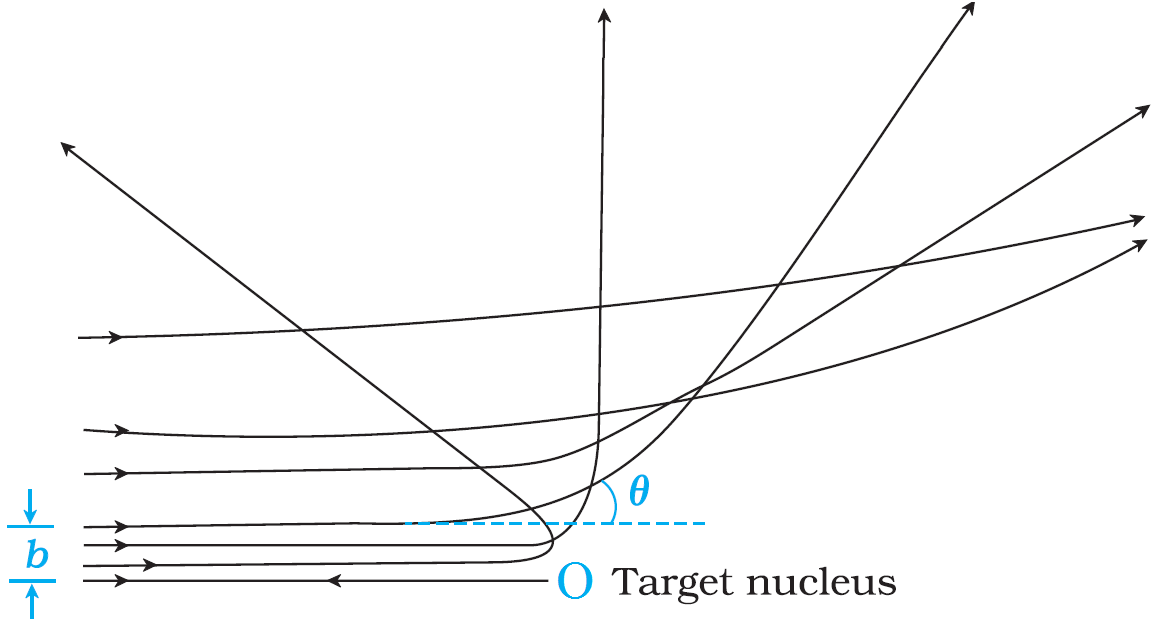
The trajectories, traced by different α-particles, in Geiger-Marsden experiment were observed as shown in the figure.
  1. What names are given to the symbols ‘b’ and $'\theta'$ shown here?
  2. What can we say about the values of b for (i) $\theta=0^{\circ}$ (ii) $\theta=\text{P}$ radians?
A bar magnet of magnetic moment $1.5 J T^{–1}$ lies aligned with the direction of a uniform magnetic field of $0.22 T$.
  1. What is the amount of work required by an external torque to turn the magnet so as to align its magnetic moment: $(i)$ normal to the field direction $,(ii)$ opposite to the field direction?
  2. What is the torque on the magnet in cases $(i)$ and $(ii)$ ?
Explain the shortcomings of Bohr's Theory.
A spherical volume contains a uniformly distributed charge of density $2.0 \times 10^{-4}Cm^{-3}.$ Find the electric field at a point inside the volume at a distance $4.0\ cm$ from the centre.
A horizontal straight wire $10m$ long extending from east to west is falling with a speed of $5.0\ ms^{–1},$ at right angles to the horizontal component of the earth’s magnetic field, $0.30 \times 10^{–4}Wbm^{–2}.$
  1. What is the instantaneous value of the emf induced in the wire?
  2. What is the direction of the emf?
  3. Which end of the wire is at the higher electrical potential?
​​​​​​​