Maharashtra BoardEnglish MediumSTD 10MathsTrigonometric Ratios2 Marks
Question
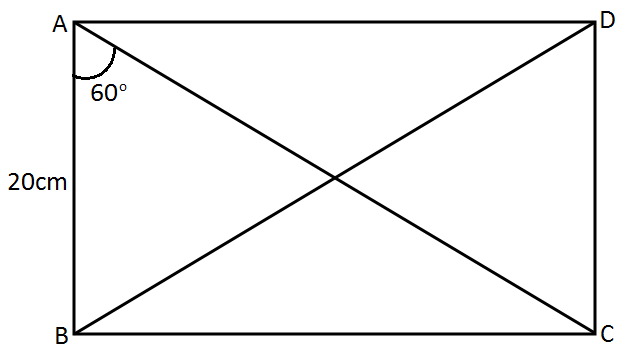
In a rectangle ABCD, AB = 20cm, $\angle\text{BAC} = 60^\circ,$ calculate side BC and diagonals AC and BD.
✓
Answer
We have drawn the following figure
Since ABCD is a rectangle Therefore, $\angle\text{ABC}=\angle\text{BCD}=90^\circ$ Now, consider $\triangle\text{ABC}$ We know that sum of all the angles of any triangle is 180° Therefore, $\angle\text{BAC}+\angle\text{ABC}+\angle\text{ACB}=180^\circ\dots(1)$ Now by substituting the values of known angles $\angle\text{BAC}$ and $\angle\text{ABC}$ in equation (1) We get, $60^\circ+90^\circ+\angle\text{ACB}=180^\circ$ $\Rightarrow150^\circ+\angle\text{ACB}=180^\circ$ $\Rightarrow\angle\text{ACB}=180^\circ-150^\circ$ $\Rightarrow\angle\text{ACB}=30^\circ$ Now in $\triangle\text{ABC}$ We know that, $\cos\text{A}=\cos60^\circ$ $\Rightarrow\frac{\text{AB}}{\text{AC}}=\cos60^\circ$ Now we have, $\cos60^\circ=\frac{1}{2}$ AB = 20cm and Therefore by substituting above values in equation (2) We get, $\cos\text{A}=\cos60^\circ$ $\Rightarrow\frac{20}{\text{AC}}=\frac{1}{2}$ Now by cross multiplying we get, $20\times2=1\times\text{AC}$ $\Rightarrow40=\text{AC}$ $\Rightarrow\text{AC}=40$ Therefore, $\text{AC}=40\text{cm}\ \dots(3)$ Now in $\triangle\text{ABC}$ We know that, $\sin\text{A}=\sin60^\circ$ $\Rightarrow\frac{\text{BC}}{\text{AC}}=\sin60^\circ$ Now we have from equation (3), $\sin60^\circ=\frac{\sqrt{3}}{2}$ AC=40cm and Therefore by substituting above values in equation (4) We get, $\sin\text{A}=\sin60^\circ$ $\Rightarrow\frac{\text{BC}}{40}=\frac{\sqrt{3}}{2}$ Now by cross multiplying we get, $\text{BC}\times2=\sqrt{3}\times40$ $\Rightarrow\text{BC}=\frac{\sqrt{3}\times40}{2}$ $\Rightarrow\text{BC}=20\sqrt{3}\text{m}$ Therefore, $\Rightarrow\text{BC}=20\sqrt{3}\text{m}\ \dots(5)$ Since ABCD is a rectangle Therefore, $\text{AB}=\text{CD}=20\text{cm}\ \dots(6)$ And $\text{BC}=\text{AD}=20\sqrt{3}\text{cm}\ \dots(7)$ Now in $\triangle\text{BCD}$ We know that, $\tan\text{B}=\frac{\text{CD}}{\text{BC}}$ Now by substituting the values of sides from equation (6) and (7) We get, $\Rightarrow\tan\text{B}=\frac{20}{20\sqrt{3}}$ $\Rightarrow\tan\text{B}=\frac{1}{\sqrt{3}}$ Since $\tan30^\circ=\frac{1}{\sqrt{3}}$ Therefore, $\angle\text{B}=30^\circ$ That is in $\triangle\text{BCD}$ $\angle\text{DBC}=30^\circ\ \dots(8)$ NOW in $\triangle\text{BCD}$ We know that, $\cos\text{B}=\frac{BC}{BD}$ From equation (7) and (8) $\Rightarrow\cos30^\circ=\frac{20\sqrt{3}}{\text{BD}}$ Since $\Rightarrow\cos30^\circ=\frac{\sqrt{3}}{2}$ Therefore, $\frac{\sqrt{3}}{2}=\frac{20\sqrt{3}}{\text{BD}}$ Now by cross multiplying we get, $\sqrt{3}\times\text{BD}=20\sqrt{3}\times2$ $\Rightarrow\sqrt{3}\times\text{BD}=40\sqrt{3}$ $\Rightarrow\text{BD}=\frac{40\sqrt{3}}{\sqrt{3}}$ $\Rightarrow\text{BD}=40$ Therefore, $\text{BD}=40\text{cm}\ \dots(9)$ Hence from equation (3), (5) and (9) $\text{AC}=40\text{cm},\ \text{BC}=20\sqrt{3}\text{cm},\ \text{BD}=40\text{cm}$
Need a full question paper?
Generate a complete, print-ready paper with questions like this in minutes — across 16+ boards, with answer keys.