MCQ
In a rectangle $ABCD\,\,(BC = 2AB)$. The moment of inertia along which axis will be minimum
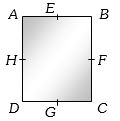
  • A
    $BC$
  • B
    $BD$
  • C
    $HF$
  • $EG$

Answer

Correct option: D.
$EG$
d
The moment of inertia will be minimum about that axis, which is passing through the center of mass.

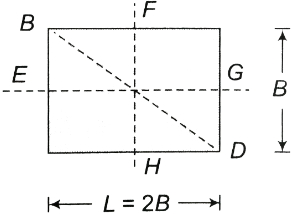
$I_{E G}=\frac{M B^{2}}{12}$

$I_{F H}=\frac{M(2 B)^{2}}{12}=\frac{M B^{2}}{6}$

$M. I.$ of the rectangular plate about its diagonal $I_{B D}=\frac{M B^{2} L^{2}}{6\left(B^{2}+L^{2}\right)}=\frac{M B^{2} \times 4 B^{2}}{6\left(B^{2}+4 B^{2}\right)}=\frac{2}{15} M B^{2}=\frac{M B^{2}}{7.5}$

$M. I.$ about $E G$ is minimum.

$\mathrm{OR}$

By observation, distribution of mass is the nearest about axis $E G .$
Need a full question paper?

Generate a complete, print-ready paper with questions like this in minutes — across 16+ boards, with answer keys.
Start Generating Free

Similar questions

In a Young's double slit experiment, the distance between the two identical slits is $6.1$ times larger than the slit width. Then the number of intensity maxima observed with in the central maximum of the single slit diffraction pattern is
A tungsten body of diameter $2.3\, cm$ is at $2000\,^oC$. It radiates $30\%$ of the energy radiated by a black body of same radius and temperature. Find radius of black body which will radiate energy at same rate at the same temperature......... $cm$
A mole of an ideal diatomic gas undergoes a transition from $A$ to $B$ along a path $AB$ as shown in the figure, The change in internal energy of the gas during the transition is ...... $kJ$
The velocity at the maximum height of a projectile is half of its initial velocity $u$. Its range on the horizontal plane is
A certain metallic surface is illuminated with monochromatic light of wavelength, $\lambda$. The stopping potential for photo-electric current for this light is $3 V_0$  . If the same surface is illuminated with light of wavelength $2\lambda$, the stopping potential is $V_0$. The threshold wavelength for this surface for photo- electric effect is
Which one of the following quantities does not have the unit of force per unit area
A ball is allowed to fall from a height of $10\, m$. If there is $40\%$ loss of energy due to impact, then after one impact ball will go up to ......... $m$
A dumbbell consisting of two masses $m$ each, connected by a light rigid rod of length $l$, falls on two pads of equal height, one steel and the other brass through a height $h$. The coefficient of restitution are $e_1$ and $e_2$ ($e_1 < e_2$). To what maximum height will the centre of mass of the dumbbell rise after bouncing of the pads?
Assertion : Mass of moving photon varies inversely as the wavelength.
Reason : Energy of the particle $= mass\times(speed \,of \,light)^2$
If a semiconductor photodiode can detect a photon with a maximum wavelength of $400\, nm ,$ then its band gap energy is

Planck's constant $h=6.63 \times 10^{-34}\, J . s$

Speed of ligh $c =3 \times 10^{8}\, m / s$