MCQ
In a region, steady and uniform electric and magnetic fields are present. These two fields are parallel to each other. A charged particle is released from rest in this region. The path of the particle will be a
  • A
    Circle
  • B
    Helix
  • Straight line
  • D
    Ellipse

Answer

Correct option: C.
Straight line
c
The charged particle will move along the lines of electric field ( and magnetic field). Magnetic field will exert no force. The force by electric field will be along the lines of uniform electric field. Hence the particle will move in a straight line

Need a full question paper?

Generate a complete, print-ready paper with questions like this in minutes — across 16+ boards, with answer keys.

Start Generating Free

Similar questions

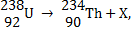
The radioactive decay of uranium into thorium is expressed by the equation where ‘X’ is
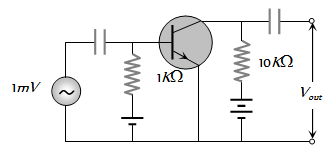
In the following common emitter configuration an NPN transistor with current gain b = 100 is used. The output voltage of the amplifier will be
Current in a circuit falls from $5.0\, A$ to $0.0\, A$ in $0.1\, s$. If an average $emf$ of $200\, V$ induced, give an estimate of the self-inductance of the circuit....$H$
If $\alpha = 0.98$ and current through emitter $i_e = 20 \,mA,$ the value of $\beta$ is
The image of an extented object, placed perpendicular to the principal axis of a mirror, will be erect if

$(a)$ The object and image both are real

$(b)$ The object and image both are virtual

$(c)$ The object is real but the image is virtual

$(d)$ The object is virtual but the image is real

A capacitor of capacitance 6μF is charged upto 100 volt. The energy stored in the capacitor is
Two photons having:
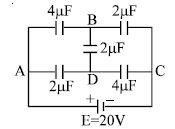
The figure shows a diagonal symmetric arrangement of capacitors and a battery. If the potential of $C$ is zero, then
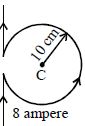
A long, straight wire is turned into a loop of radius $10\,cm$ (see figure). If a current of $8\, A$ is passed through the loop, then the value of the magnetic field and its direction at the centre $C$ of the loop shall be close to
One junction of a certain thermoelectric couple is at a fixed temperature $T_t$ and the other junction is at temperature T. The thermo electromotive force for this is expressed by E = K$(T-T_r)[T_0-\frac{1}{2}(T+T_r)]$ . At temperature ${T}=\frac{1}{2} {~T}_0$, the thermoelectric power is