MCQ
In a reversible isochoric change
  • $\Delta W=0$
  • B
    $\Delta Q=0$
  • C
    $\Delta T=0$
  • D
    $\Delta U=0$

Answer

Correct option: A.
$\Delta W=0$
$\Delta V=0$
$\Rightarrow P \Delta V=0$
$\Rightarrow \Delta W=0$

Need a full question paper?

Generate a complete, print-ready paper with questions like this in minutes — across 16+ boards, with answer keys.
Start Generating Free

Similar questions

For a reversible process, necessary condition is
A linear harmonic oscillator of force constant $2 \times 10^6 N / m$ times and amplitude $0.01 m$ has a total mechanical energy of $160$ joules. $1$
  1. Maximum potential energy is $100 J$
  2. Maximum $K.E$. is $100 J$
  3. Maximum $P.E$. is $160 J$
  4. Minimum $P.E$. is zero
There are two force vectors, one of $5 N$ and other of $12 N$ at what angle the two vectors be added to get resultant vector of $17 N , 7 N$ and $13 N$ respectively
A body of mass $m$ is moving in a circle of radius $r$ with a constant speed $v$. The force on the body is $\frac{m v^2}{r}$ and is directed towards the centre. What is the work done by this force in moving the body over half the circumference of the circle
A black body is at a temperature of $2880 \mathrm{~K}$. The energy of radiation emitted by this object with wavelength between $499 \mathrm{~nm}$ and $500 \mathrm{~nm}$ is $U_1$, between $999 \mathrm{~nm}$ and $1000 \mathrm{~nm}$ is $U_2$ and between $1499 \mathrm{~nm}$ and $1500 \mathrm{~nm}$ is $U_3$. The Wein's constant $b=2.88 \times 10^6 \mathrm{~nm} \mathrm{~K}$. Then
A heater coil connected to a supply of a $220 \quad V$ is dissipating some power $P_1$. The coil is cut into half and the two halves are connected in parallel. The heater now dissipates a power $P_2$. The ratio of power $P_1: P_2$ is
If the excess pressure inside a soap bubble is balanced by oil column of height $2 \mathrm{~mm}$, then the surface tension of soap solution will be ( $r$ $=1 \mathrm{~cm}$ and density $d=0.8 \ \mathrm{gm} / \mathrm{cc}$ )
Two lenses are placed in contact with each other and the focal length of combination is $80 \mathrm{~cm}$. If the focal length of one is $20 \mathrm{~cm}$, then the power of the other will be
A moving body of mass $\mathrm{m}$ and velocity $3 \mathrm{~km} / \mathrm{h}$ collides with a rest body of mass $2 \mathrm{~m}$ and sticks to it. Now the combined mass starts to move. What will be the combined velocity
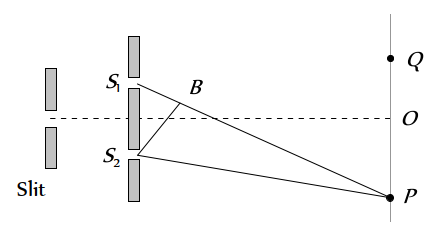
In the figure is shown Young's double slit experiment. $Q$ is the position of the first bright fringe on the right side of $O . P$ is the $11^*$fringe on the other side, as measured from $Q$. If the wavelength of the light used is $6000 \times 10^{-10} m$, then $S _1 B$ will be equal to

Image