- ✓$\frac{{{k_1}a - {k_2}b}}{{{k_1}\, + \,{k_2}}}$
- B$\frac{{{k_1}a - {k_2}b}}{{{k_1}\, - \,{k_2}}}$
- C$\frac{{{k_1}a - {k_2}b}}{{{k_1}{k_2}}}$
- D$\frac{{{k_1}a + {k_2}b}}{{{k_1}\, + \,{k_2}}}$
$\mathrm{K}_{1} \mathrm{a}-\mathrm{K}_{1} \mathrm{x}=\mathrm{K}_{2} \mathrm{b}+\mathrm{K}_{2} \mathrm{x}$
$\mathrm{K}_{1} \mathrm{a}-\mathrm{K}_{2} \mathrm{b}=\left(\mathrm{K}_{1}+\mathrm{K}_{2}\right) \mathrm{x}$
$\mathrm{x}=\frac{\mathrm{K}_{1} \mathrm{a}-\mathrm{K}_{2} \mathrm{b}}{\mathrm{K}_{1}+\mathrm{K}_{2}}$
Generate a complete, print-ready paper with questions like this in minutes — across 16+ boards, with answer keys.
$Zn(s) + N{i^{2 + }}(a = 1.0)$ $\rightleftharpoons$ $Z{n^{2 + }}(a = 10) + Ni(s)$ occurs, is found to be $0.5105\,V$ at $298\,K$. The standard e.m.f. of the cell is ............ $\mathrm{V}$
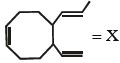
$(ii)$ Number of cyclic structural isomers with molecular formula $C_5H_{10} = Y$
$(iii)$ Number of ether with $M.F. C_4H_{10}O = Z ;X + Y + Z$ is

Assertion : For hydrogenation reactions, the catalytic activity increases from Group $5$ to Group $11$ metals with maximum activity shown by Group $7-9$ elements.
Reason : The reactants are most strongly adsorbed on group $7-9 $ elements.