Question
In a right triangle $ABC, ÐB = 90^\circ $. If $AC = 13 \ cm, BC = 5 \ cm$, find $AB$

Answer

$\triangle\text{ABC}$is right−angled at $B.$
Therefore, by applying pythagoras theoram, we obtain
$ A C^2=A B^2+B C^2 $
$ (13 \mathrm{~cm})^2=(A B)^2+(5 \mathrm{~cm})^2 $
$ A B^2=\left(13 \mathrm{~cm}^2\right)-(5 \mathrm{~cm})^2=(169-25) \mathrm{cm}^2 $
$ =144 \mathrm{~cm}^2 $
$\text{AB}=(\sqrt{144})\text{cm} = (\sqrt{12\times12})\text{cm}$
$\text{AB} = 12 \text{cm} $

Need a full question paper?

Generate a complete, print-ready paper with questions like this in minutes — across 16+ boards, with answer keys.

Start Generating Free

Similar questions

Name the property under multiplication used in the following: $\frac{-4}{5}\times1=1\times\frac{-4}{5}=-\frac{4}{5}$
Out of the total population of a town, $60 \%$ are males and the rest are females. $20 \%$ of the males and $25 \%$ of the females are illiterate. $85 \%$ of the males and $60 \%$ of the females are employed.
(1) What percentage of the total population is illiterate?
(a) $22 \%$$\quad$(b) $28 \%$$\quad$(c) $35 \%$$\quad$(d) $45 \%$
(2) What is the ratio of the number of literate males to that of illiterate females?
(a) $16: 5$$\quad$(b) $4: 5$$\quad$(c) $24: 5$$\quad$(d) $12: 5$
(3) What percentage of the total population is unemployed?
(a) $25 \%$$\quad$(b) $28 \%$$\quad$(c) $35 \%$$\quad$(d) $45 \%$
(4) What is the ratio of the number of employed males to that of employed females?
(a) $17: 12$$\quad$(b) $8: 3$$\quad$(c) $16: 15$$\quad$(d) $17: 8$
During a mathematics class, a teacher once gave her students a surprise test to review their knowledge of basic concepts on quadrilaterals. She mentioned the special properties of specific quadrilaterals on different slips and asked each of her students to pick one slip each and identify the quadrilaterals from the given property.
(1) Student A picked the following slip.
A quadrilateral whose all sides, diagonals and angles are equal
A's reply would be
(a) trapezium (b) rhombus (c) rectangle (d) square
(2) Student B picked the following slip.
A quadrilateral whose adjacent sides are equal
B's reply would be
(a) rectangle (b) rhombus (c) trapezium (d) kite
(3) Student C picked the following slip.
A quadrilateral which has the properties of a kite and a parallelogram
C's reply would be
(a) trapezium (b) rhombus (c) rectangle (d) isosceles trapezium
(4) Student D picked the following slip.
A quadrilateral in which only one diagonal bisects the other
D's reply would be
(a) rectangle (b) rhombus (c) trapezium (d) kite
Q.1. Student E picked the following slip.
A quadrilateral in which each diagonals bisects the angles at the vertices through which it passes
E's reply would be
(a) parallelogram (b) rectangle (c) rhombus (d) square
Find the square root of the following decimal numbers.
$2.56$
Draw the front, side and top view of the given shapes.
For each of the following numbers, find the smallest whole number by which it should be divided so as to get a perfect square. Also find the square root of the square number so obtained.$2925$
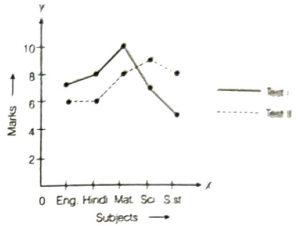
The graph given below, shows the marks obtained out of 10 by Sonia in two different tests. Study the graph and answer the questions that follow.
Image
(i) What information is represented by the axes?
(ii) In which subject did she score the highest in test I?
(iii) In which subject did she score the least in test II?
(iv) In which subjects did she score the same marks in both the tests?
Name the property under multiplication used in the following:$\frac{-19}{29}\times\frac{29}{-19}=1$
Three quantities $x, y$ and $z$ are such that $x$ and $y$ are directly proportional to each other while $y$ and $z$ are inversely proportional to each other. If $x=12$ then $y=72$ and $z=8$.

(1) If $y=42$ then $x$ is equal to
(a) 6
(b) 7
(c) 8
(d) 10

(2) If $z=12$ then $y$ is equal to
(a) 36
(b) 48
(c) 60
(d) 64

(3) Which of the following cannot be a possible combination of the values of $x$ and $y$ ?
(a) 6.5 and 39
(b) 9 and 54
(c) 47 and 282
(d) 52 and 260

(4) If $x=24$ then $z$ is equal to
(a) 4
(b) 6
(c) 8
(d) 12