Question
In a rotating body, $\text{a}=\alpha\text{r}$ and $\text{v}=\omega\text{r}.$ Thus $\frac{\text{a}}{\alpha}=\frac{\text{v}}{\omega}.$ Can a co you use the theorems of ratio and proportion studied in algebra so as to write $\frac{\text{a}+\alpha}{\text{a}-\alpha}=\frac{\text{v}+\omega}{\text{v}-\omega}$
Answer

No, we cannot use componendo-dividendo theorem of proportion here. This is because $\alpha$ and a, and v and $\omega$ are dimensionally different. Therefore, ​$\text{v}+\omega$ and/ or $\alpha+\text{a}$ are not possible.

Need a full question paper?

Generate a complete, print-ready paper with questions like this in minutes — across 16+ boards, with answer keys.

Start Generating Free

Similar questions

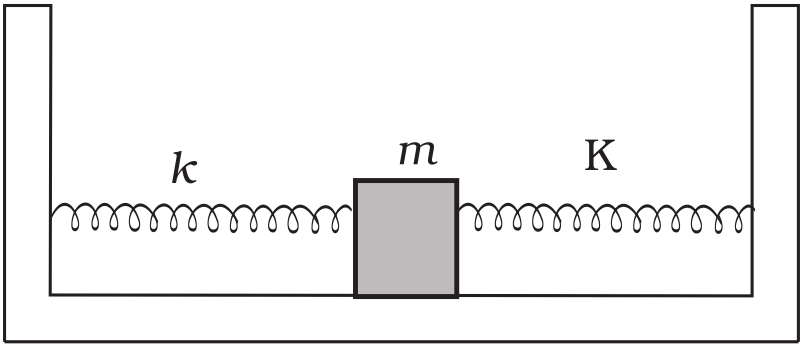
Two identical springs of spring constant K are attached to a block of mass m and to fixed supports as shown in Fig. When the mass is displaced from equilllibrium position by a distance x towards right, find the restoring force.
Gravitational force with which a body is attracted towards the centre of the earth is __________ of the body.
A charged particle is projected at a very high speed perpendicular to a uniform magnetic field. The particle will:
What causes the rolling sound of thunder?
A body of mass 2kg initially at rest moves under the action of an applied horizontal force of 7N on a table with coefficient of kinetic friction = 0.1. Compute the: Work done by the applied force in 10s.
What is the gravitational potential at infinity?
A car travels at a speed of 60km/hr due north and the other at a speed of 60km/hr due east. Are the velocities equal? If no, which one is greater? If you find any of the questions irrelevant, explain.
A sphere of radius 1.00cm is placed in the path of a parallel beam of light of large aperture. The intensity of the light is $0.5W/cm^{-2}$. If the sphere completely absorbs the radiation falling on it, find the force exerted by the light beam on the sphere.
Every SHM is periodic motion, but every periodic motion need not to be a simple harmonic motion. Do you agree? Give an example to justify your statement.
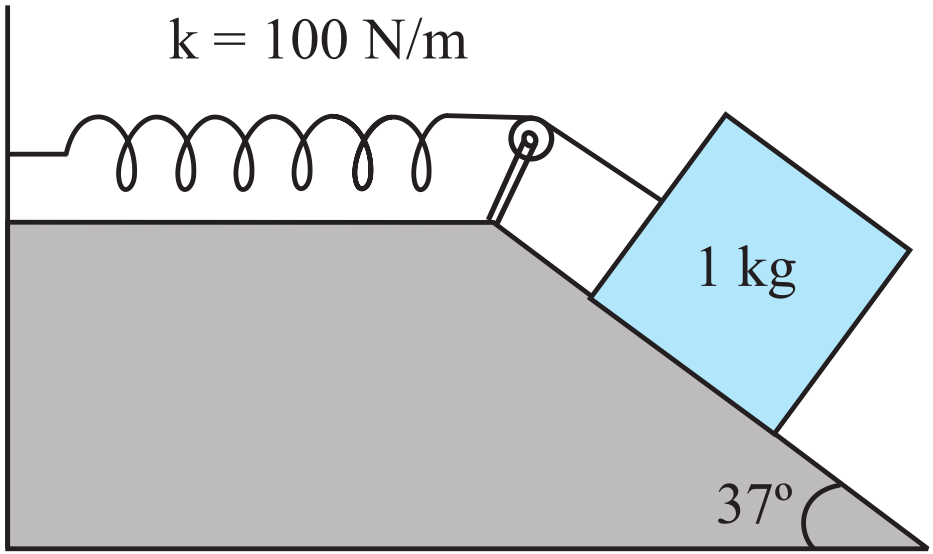
A $1kg$ block situated on a rough incline is connected to a spring of spring constant $100Nm^{-1}$ as shown in. The block is released from rest with the spring in the unstretched position. The block moves $10cm$ down the incline before coming to rest. Find the coefficient of friction between the block and the incline. Assume that the spring has a negligible mass and the pulley is frictionless.