Question
In a simple Atwood machine, two unequal masses $m_1$ and $m_2$ are connected by a string going over a clamped light smooth pulley. In a typical arrangement $m_1 = 300g$ and $m_2 = 600g$. The system is released from rest.
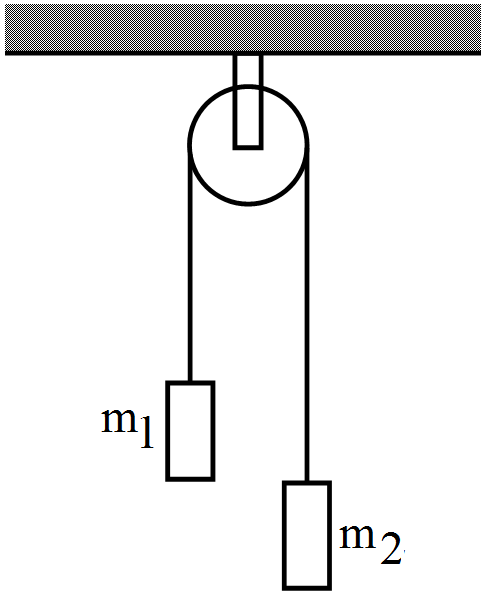
  1. Find the distance travelled by the first block in the first two seconds.
  2. Find the tension in the string.
  3. Find the force exerted by the clamp on the pulley.
Answer


$m_1 = 0.3kg, m_2 = 0.6kg$
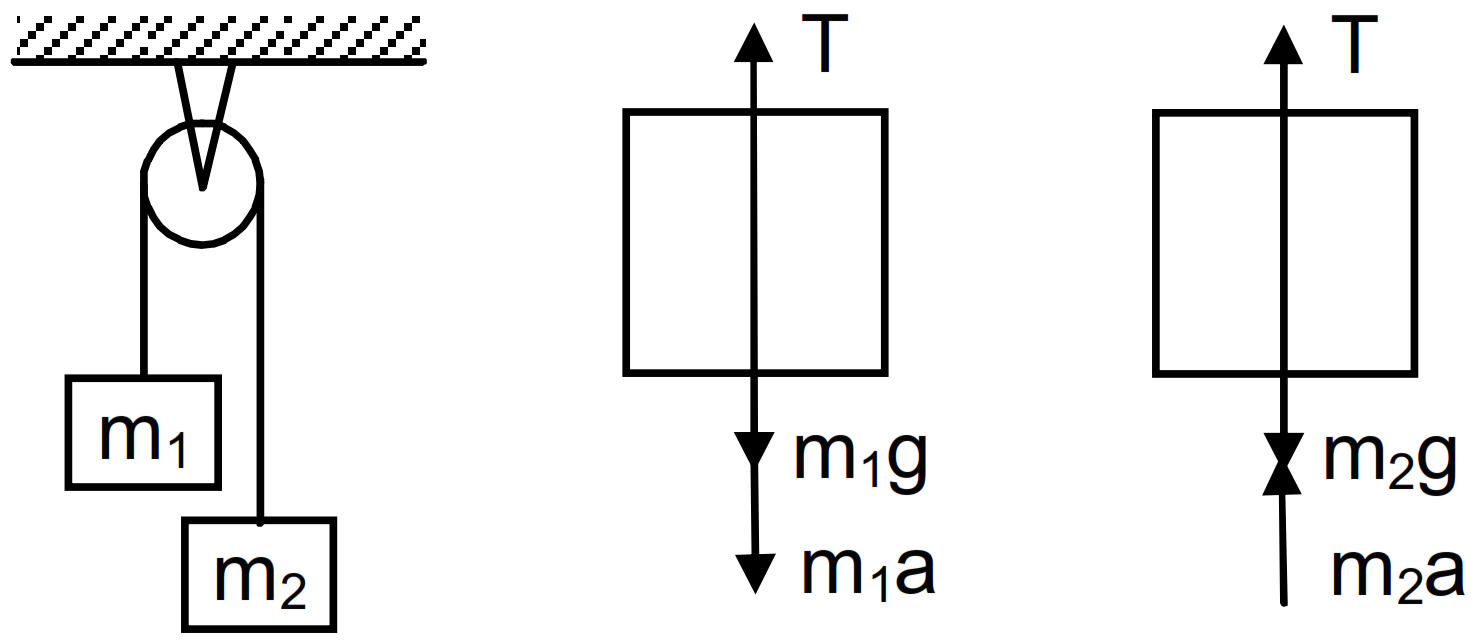
$T - (m_1g + m_1a) = 0 …(i)$
$\Rightarrow T = m_1g + m_1a$
$T + m_2a - m_2g = 0 …(ii)$
$\Rightarrow T = m_2g - m_2a$
From equation (i) and equation (ii)
$m_1g + m_1a + m_2a - m_2g = 0$, from (i)
$\Rightarrow a(m_1 + m_2) = g(m_2 - m_1)$
$\Rightarrow\text{a = f}\Big(\frac{\text{m}_2-\text{m}_1}{\text{m}_1-\text{m}_2}\Big)=9.8\Big(\frac{0.6-0.3}{0.6+0.3}\Big)=3.266\text{ms}^{-2}.$
  1. t = 2 sec acceleration $= 3.266 ms^{-2}$​​​​​​​
Initial velocity u = 0
So, distance travelled by the body is,
$\text{S = ut}+\frac{1}{2}\text{at}^2\Rightarrow0+\frac{1}{2}(3.266)2^2=6.5\text{m}$
  1. From $(i) T = m_1(g + a) = 0.3(9.8 + 3.26) = 3.9N$
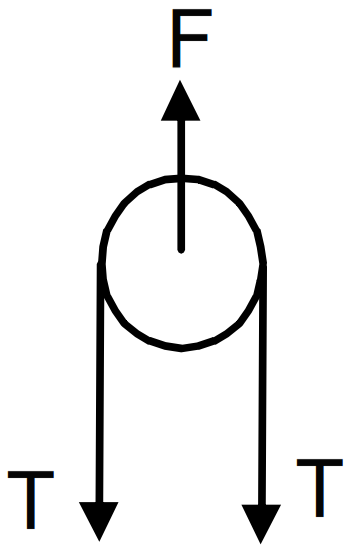
  2. The force exerted by the clamp on the pully is given by
$F - 2T = 0$
$F = 2T = 2 \times 3.9 = 7.8N$.

Need a full question paper?

Generate a complete, print-ready paper with questions like this in minutes — across 16+ boards, with answer keys.

Start Generating Free

Similar questions

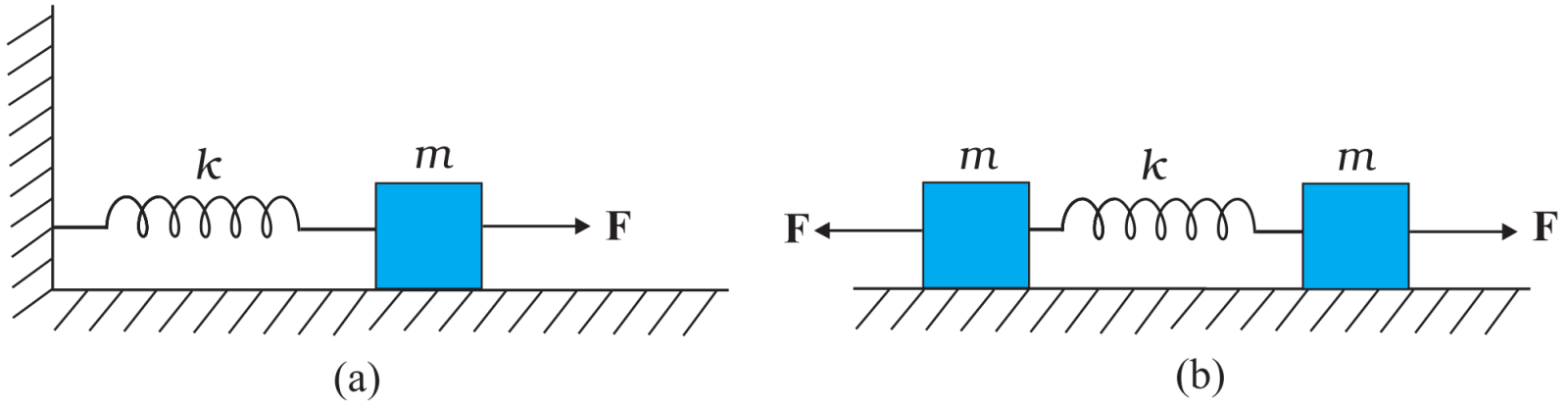
Figure (a) shows a spring of force constant k clamped rigidly at one end and a mass m attached to its free end. A force F applied at the free end stretches the spring. Figure (b) shows the same spring with both ends free and attached to a mass m at either end. Each end of the spring in Fig. (b) is stretched by the same force F.
If the mass in Fig. (a) and the two masses in Fig. (b) are released, what is the period of oscillation in each case?
A boy standing on a stationary lift (open from above) throws a ball upwards with the maximum initial speed he can, equal to $49m s^{–1}$. How much time does the ball take to return to his hands? If the lift starts moving up with a uniform speed of $5m s^{-1}$ and the boy again throws the ball up with the maximum speed he can, how long does the ball take to return to his hands?
Write Stefan's law and with the help of it establish a relation between the rate of fall in temperature and rate of emission of radiation.
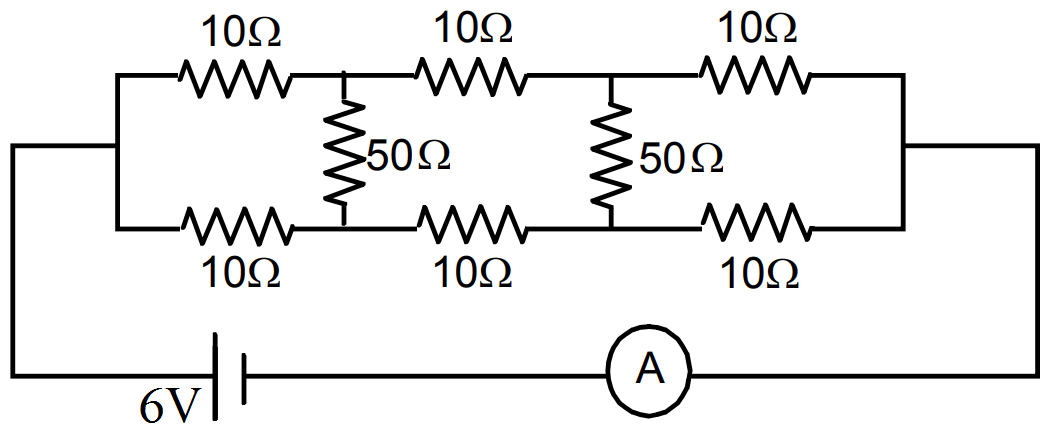
Find the current measured by the ammeter in the circuit shown in the figure.
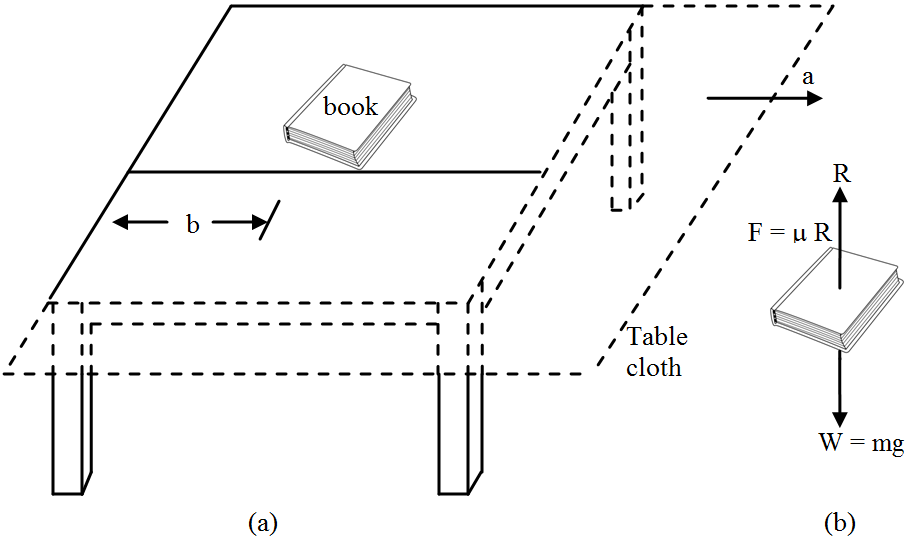
A book rests on a table cloth spread over a table as shown in Fig. The centre of the book is at a distance of b from the edge of the table at time t = 0; the table cloth is suddenly pulled at this instant with an acceleration a. Show that the cloth will slip from under the book if a > µ g, where u is the coefficient of sliding friction between the table cloth and the book. Assuming this condition to be satisfied. calculate:
  1. Time instant.
  2. The velocity.
  3. The distance of the centre of the book from the edge of the table when the edge of the table cloth passes over the centre of the book.
A hoop of radius $2m$ weighs $100kg$. It rolls along a horizontal floor so that its centre of mass has a speed of $20cm/s$. How much work has to be done to stop it?
Consider the situation shown in figure. The switch S is open for a long time and then closed:
  1. Find the charge flown through the battery when the switch S is closed.
  2. Find the work done by the battery.
  3. Find the change in energy stored in the capacitors.
  4. Find the heat developed in the system.
The energy from the sun reaches just outside the earth's atmosphere at a rate of $1400W/m^2$. The distance between the sun and the earth is $1.5 \times 10^{11}m$.
  1. Calculate the rate at which the sun is losing its mass.
  2. How long will the sun last assuming a constant decay at this rate? The present mass of the sun is $2 \times 10^{80}kg$.
Oxygen is filled in a closed metal jar of volume $1.0 \times 10^{-3} \mathrm{~m}^3$ at a pressure of $1.5 \times 10^5 \mathrm{~Pa}$ and temperature 400 K . The jar has a small leak in it. The atmospheric pressure is $1.0 \times 10^5 \mathrm{~Pa}$ and the atmospheric temperature is 300 K Find the mass of the gas that leaks out by the time the pressure and the temperature inside the jar equalise with the surrounding.
A body of mass 2kg is lying on a rough inclined plane of inclination 30°. Find the magnitude of the force parallel to the incline needed to make the block move:
  1. Up the incline
  2. Down the incline. Coefficient of static friction = 0.2.