MCQ
In a simple harmonic wave, minimum distance between particles in same phase always having same speed, is ..........
- ✓$\lambda / 4$
- B$\lambda / 3$
- C$\lambda / 2$
- D$\lambda$
$y=A \sin (\omega t-k x)$
$\frac{d y}{d t}=A \omega \cos (\omega t-k x)$
Take $x=0$ and $x=x_1$
$v_1=A \omega \cos (\omega t)$
$v_2=A \omega \cos (\omega t+k x)$
$\left|v_1\right|=\left|v_2\right|$
$|\cos (\omega t)|=|\cos (\omega t+k x)|$
$\therefore k x=\frac{\pi}{2}$
or $x=\frac{\lambda}{4}$
Generate a complete, print-ready paper with questions like this in minutes — across 16+ boards, with answer keys.
$Image$
$(A)$ $\mu_1=0 \mu_2 \neq 0$ and $N _2 \tan \theta=\frac{ mg }{2}$
$(B)$ $\mu_1 \neq 0 \mu_2=0$ and $N_1 \tan \theta=\frac{m g}{2}$
$(C)$ $\mu_1 \neq 0 \mu_2 \neq 0$ and $N _2 \tan \theta=\frac{ mg }{1+\mu_1 \mu_2}$
$(D)$ $\mu_1=0 \mu_2 \neq 0$ and $N _1 \tan \theta=\frac{ mg }{2}$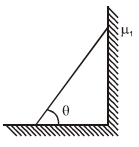
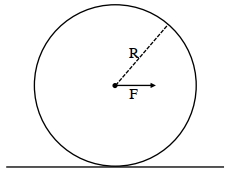
$(A)$ For the same $F$, the value of $a$ does not depend on whether the cylinder is solid or hollow
$(B)$ For a solid cylinder, the maximum possible value of $a$ is $2 \mu g$
$(C)$ The magnitude of the frictional force on the object due to the ground is always $\mu m g$
$(D)$ For a thin-walled hollow cylinder, $a=\frac{F}{2 m}$