- Increase.
- Decrease.
- Remain the saint.
- May increase or decrease.
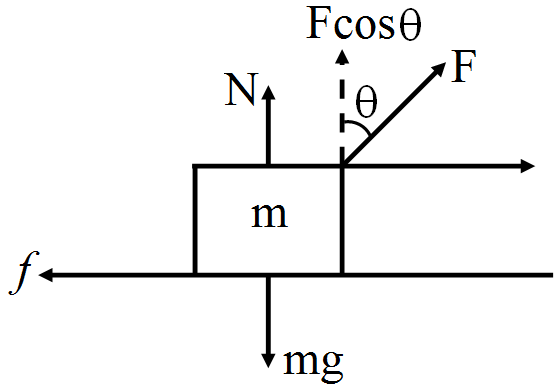
Explanation:

According to the first law of limiting friction,
$\text{f}=\mu\text{N}$
where f is the frictional force
N is the normal reaction force
$\mu$ is the coefficient of static friction
and
$\text{N = mg}-\text{F}\cos\theta$
where m is the mass of the body
F is the contact force acting on the body
If we decrease the angle between this contact force and the vertical, then $\text{F}\cos\theta$ increases and the normal reaction force (N) as well as the frictional force (f) decrease.
Generate a complete, print-ready paper with questions like this in minutes — across 16+ boards, with answer keys.
A polariser is used to
|
(a) Reduce intensity of light |
(b) Produce polarised light |
|
(c) Increase intensity of light |
(d) Produce unpolarised light |
Two thin lenses, one of focal length + 60 cm and the other of focal length – 20 cm are put in contact. The combined focal length is
|
(a) + 15 cm |
(b) – 15 cm |
(c) + 30 cm |
(d) –30 cm |
Quantam nature of light is explained by which of the following phenomenon
|
(a) Huygen wave theory |
(b) Photoelectric effect |
|
(c) Maxwell electromagnetic theory |
(d) de-Broglie theory |
A candle placed 25 cm from a lens, forms an image on a screen placed 75 cm on the other end of the lens. The focal length and type of the lens should be
|
(a) + 18.75 cm and convex lens |
(b) – 18.75 cm and concave lens |
|
(c) + 20.25 cm and convex lens |
(d) – 20.25 cm and concave lens |
For a glass prism, the angle of minimum deviation will be smallest for the light of:
A wire has resistance 12 Ω. It is bent in the form of a circle. The effective resistance between the two points on any diameter is equal to
|
(a) 12 Ω |
(b) 6 Ω |
(c) 3 Ω |
(d) 24 Ω |