MCQ
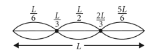
In a sonometer experiment, the string of length $L$ under tension vibrates in second overtone between two bridges. The amplitude of vibration is maximum at
  • A
    $\frac{L}{3}, \frac{2 L}{3}, \frac{5 L}{6}$
  • B
    $\frac{L}{8}, \frac{L}{4}, \frac{L}{2}$
  • C
    $\frac{L}{2}, \frac{L}{4}, \frac{L}{6}$
  • $\frac{L}{6}, \frac{L}{2}, \frac{5 L}{6}$
Answer

Correct option: D.
$\frac{L}{6}, \frac{L}{2}, \frac{5 L}{6}$
(d) : String vibrating in second overtone
Image
So, the amplitude of vibration is maximum at $\frac{L}{6}, \frac{L}{2}, \frac{5 L}{6}$

Need a full question paper?

Generate a complete, print-ready paper with questions like this in minutes — across 16+ boards, with answer keys.

Start Generating Free

Similar questions

A disc has mass ' $M$ ' and radius ' $R$ '. How much tangential force should be applied to the rim of the disc so as to rotate with angular velocity ' $\omega$ ' in time ' $t$ '?
In biprism experiment, the distance between source and eyepiece is $1.2 m$, the distance between two virtual sources is $0.84 mm$. Then the wavelength of light used if eyepiece is to be moved transversely through a distance of $2.799 cm$ to shift 30 fringes is
The electrons are emitted in the photoelectric effect from a metal surface.
Interference fringes are produced on a screen by using two light sources of intensities $I$ and $9 I$. The phase difference between the beams is $\frac{\pi}{2}$ at point $P$ and $\pi$ at point $Q$ on the screen. The difference between the resultant intensities at point $P$ and $Q$ is
A long solenoid has 1500 turns. When a current of 3.5 A flows through it, the magnetic flux linked with each turn of solenoid is $2.8 \times 10^{-3}$ weber. The self-inductance of solenoid is
In a common base configuration, the transistor has an emitter current of 10 mA and a collector current of 9.8 mA. The value of base current is ______ 
Two copper spheres of radii $6 \mathrm{~cm}$ and $12 \mathrm{~cm}$, respectively, are suspended in an evacuated enclosure. Each of them is at a temperature of $15^{\circ} \mathrm{C}$ above the surroundings. The ratio of their rate of loss of heat is
Two spherical soap bubbles of radi ' $a$ ' and ' $b$ ' in vacuum coalesce under isothermal conditions. The resulting bubble has a radius equal to
A thin uniform rod of mass M and length L has a small block of mass M attached at one end. The moment of inertia of the system about an axis through its CM and perpendicular to the length of the rod is
A mass ' $M$ ' is moving with constant velocity parallel to $X$-axis. Its angular momentum with respect to the origin is