MCQ
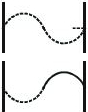
 In a standing wave on a string rigidly fixed at both ends
  • A
    all the particles must be at their positive extremes simultaneously once in half of the time period.
  • B
    all the particles must be at their positive extremes simultaneously once in a time period.
  • in one time period all the particles are simultaneously at rest twice.
  • D
    all the particle are never at rest simultaneously
Answer

Correct option: C.
in one time period all the particles are simultaneously at rest twice.
c
In stationary wave pattern, the particles reaches their extreme position twice in one line period.

Need a full question paper?

Generate a complete, print-ready paper with questions like this in minutes — across 16+ boards, with answer keys.

Start Generating Free

Similar questions

A thin wire of length $l$ and mass $M$ is bent in the form of a semi-circle. What is its moment of inertia about an axis passing through the ends of the wire
A vertical cylinder with heat-conducting walls is closed at the bottom and is fitted with a smooth light piston. It contains one mole of an ideal gas. The temperature of the gas is always equal to the surrounding’s temperature, $T_0$. The piston is moved up slowly to increase the volume of the gas to $\eta$ times. Which of the following is incorrect?
A particle is moved from $(0, 0)$  to $(a, a)$  under a force $F = (3\hat i + 4\hat j)$ from two paths. Path $1$ is $OP$ and path $2$  is $OQP$ . Let $W_1$ and $W_2$ be the work done by this force in these two paths respectively. Then
A particle has initial velocity $(2\hat i + 3\hat j ) $ and has acceleration $(0.3\,\hat i + 0.2\,\hat j)$ . Its speed after $10\,s$ is
Two waves are represented by the equations : $y_1 = a\, sin\,(\omega t + kx + 0.57)\, m$ and $y_2 = a\, cos\,(\omega t + kx)\, m$, where $x$ is in $metres$ and $t$ is in $seconds$ . The phase difference between them is ..... $radian$
A fire hydrant delivers water of density $\rho $ at a volume rate $L$. The water travels vertically upward through the hydrant and then does $90^o$ turn to emerge horizontally at speed $V$. The pipe and nozzle have uniform cross-section throughout. The force exerted by the water on the corner of the hydrant is
$Assertion :$ For higher temperature the peak emission wavelength of a blackbody shifts to lower wavelengths.

$Reason :$ Peak emission wavelengths of a black body is proportional to the fourth-power of temperature.

The unit vector along $\hat i + \hat j$ is
A ladder rests against a frictionless vertical wall, with its upper end $6\,m$ above the ground and the lower end $4\,m$ away from the wall. The weight of the ladder is $500 \,N$ and its C. G. at $1/3^{rd}$ distance from the lower end. Wall's reaction will be, (in Newton)
Two vessels $A$ and $B$ are of the same size and are at same temperature. A contains $1 \mathrm{~g}$ of hydrogen and $B$ contains $1 \mathrm{~g}$ of oxygen. $\mathrm{P}_{\mathrm{A}}$ and $\mathrm{P}_{\mathrm{B}}$ are the pressures of the gases in $A$ and $\mathrm{B}$ respectively, then $\frac{\mathrm{P}_{\mathrm{A}}}{\mathrm{P}_{\mathrm{B}}}$ is: