MCQ
In a transistor configuration b-parameter is
  • A
     $\frac{l_b}{1_c}$
  • $\frac{l_{ c }}{1_b}$
  • C
     $\frac{l_{ c }}{1_{ a }}$
  • D
    $\frac{1_{ a }}{1_{ c }}$

Answer

Correct option: B.
$\frac{l_{ c }}{1_b}$

Need a full question paper?

Generate a complete, print-ready paper with questions like this in minutes — across 16+ boards, with answer keys.

Start Generating Free

Similar questions

Match List$-I$ with List$-II$

List$-I$  List$-II$
$A.$ Television signal $I.$ $03\,KHz$
$B.$ Radio signal $II.$ $20\,KHz$
$C.$ High Quality Music $III.$ $02\,MHz$
$D.$ Human speech $IV.$ $06\,MHz$

Choose the correct answer from the options given below
What will be the ratio of de-Broglie wavelengths of proton and $\alpha - $ particle of same energy
Two coherent sources of intensities, $\mathrm{I}_1$ and $\mathrm{I}_2$ produce an interference pattern. The maximum intensity in the interference pattern will be
The frequency of revolution of a charged particle in a cyclotron does not depend on $‘X\ ’$. Identify $X.$
The fact that the conductance of some metals rises to infinity at some temperature below a few Kelvin is called
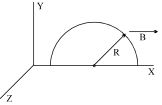
$A$ semicircle conducting ring of radius $R$ is placed in the $xy$ plane, as shown in the figure. $A$ uniform magnetic field is set up along the $x$ -axis. No $emf$, will be induced in the ring. if
In a medium, the force of attraction between two point charges, distance $d$ apart, is $F$. What distance apart should these point charges be kept in the same medium, so that the force between them becomes $16\, F$ ?
Given below are two statements

Statement $I$ : The electric force changes the speed of the charged particle and hence changes its kinetic energy: whereas the magnetic force does not change the kinetic energy of the charged particle

Statement $II$ : The electric force accelerates the positively charged particle perpendicular to the direction of electric field. The magnetic force accelerates the moving charged particle along the direction of magnetic field. In the light of the above statements, choose the most appropriate answer from the options given below

Two unlike charges attract each other with a force of $10N.$ If the distance between them is doubled, the force between them is:
The magnetic moment $(\mu )$ of a revolving electron around the nucleus varies with principal quantum number $n$ as