Question
In a transistor:

Answer

  1. The base has the least concentration of impurity.

Need a full question paper?

Generate a complete, print-ready paper with questions like this in minutes — across 16+ boards, with answer keys.
Start Generating Free

Similar questions

According to de$-$Broglie, the de$-$Broglie wavelength for electron in an orbit of hydrogen atom is $10^{–9} m$. The principle quantum number for this electron is
Light of frequency $n$ is incident on a certain photoelectric substance with threshold frequency $n_0$. The work function for the substance is
For an LCR circuit, the power transferred from the driving source to the driven oscillator is $\text{P}=\text{FZ}\cos\phi$.
Excitation energy of a hydrogen like ion in its first excitation state is 40.8 eV. Energy needed to remove the electron from the ion in ground state is(a) 54.4 eV(b) 13.6 eV(c) 40.8 eV(d) 27.2 eV
       
The half$-$life of a radioactive substance against $a-$decay is $1.2 \times 10^7 s.$ What is the decay rate for $4 \times 10^{15}$  atoms of the substance
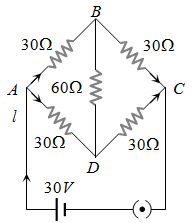
The current between $B$ and $D$ in the given figure is
The rest mass of an electron as well as that of positron is 0.51 MeV. When an electron and positron are annihilate, they produce gamma-rays of wavelength(s)(a) 0.012 Å(b) 0.024 Å(c) 0.012 Å to ¥(d) 0.024 Å to ¥
       
A plane mirror reflects a pencil of light to form a real image. Then the pencil of light incident on the mirror is(a) Parallel(b) Convergent(c) Divergent(d) None of the above
       
The potential gradient at which the dielectric of a condenser just gets punctured is called:
In Balmer series of emission spectrum of hydrogen, first four lines with different wavelength $\text{H}\alpha $ $ \text{H}\beta$ $\text{H}\gamma$ and $\text{H}\delta$ are obtained. Which line has maximum frequency out of these?