Question
In a $\triangle\text{ABC, D}$ and $E$ are points on the sides $AB$ and $AC$ respectively. For the following cases show that $DE || BC:$
$AB = 5.6\ cm, AD = 1.4\ cm, AC = 7.2$ and $AE = 1.8\ cm$.
Answer

Given $AB = 5.6\ cm, AD = 1.4\ cm, AC = 7.2\ cm$ and $AE = 1.8\ cm$
Now, $\frac{\text{AD}}{\text{AB}}=\frac{1.4}{5.6}=\frac{1}{4}$
And, $\frac{\text{AE}}{\text{AC}}=\frac{1.8}{7.2}=\frac{1}{4}$
$\therefore\frac{\text{AD}}{\text{AB}}=\frac{\text{AE}}{\text{AC}}$
Thus, $DE$ divides sides $AB$ and $AC$ of $\triangle\text{ABC}$ in the same ratio. Therefore, by converse of basic proportionality theorem, we have $DE || BC.$

Need a full question paper?

Generate a complete, print-ready paper with questions like this in minutes — across 16+ boards, with answer keys.

Start Generating Free

Similar questions

The shadow of a tower standing on a level ground is found to be $40\ m$ longer when the Sun's altitude is $30^\circ$, than when it is $60^\circ$. Find the height of the tower.
Check whether $6^n$ can end with the digit $0$ for any natural number $n$.
Write the sequence with $\mathrm{n}^{\text {th }}$ term:
$a_n= 9 - 5n.$
Show the all of the above sequences form A.P.
Find the number of terms in $AP. 18,$ $15\frac{1}{2}$$, 13, ….., – 47.$
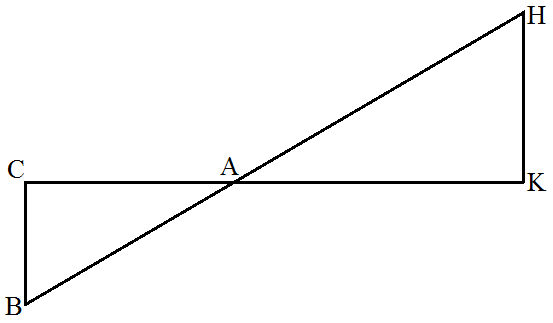
In the given figure, $\triangle\text{AHK}$ is similar to $\triangle\text{ABC}.$ If $AK = 10\ cm, BC = 3.5\ cm$ and $HK = 7\ cm,$ find $AC.$
In $\triangle\text{ABC},$ points $P$ and $Q$ are on $CA$ and $CB,$ respectively such that $CA = 16\ cm, CP = 10\ cm, CB = 30\ cm$ and $CQ = 25\ cm.$ Is $PQ || AB?$
Find the sum of the first $25$ terms of an $A.P.$ whose $n^{th}$ term is given by $a_n= 2 - 3n.$
Write a quadratic polynomial, sum of whose zeros is $2\sqrt{3}$ and their product is $2.$
A small terrace at a football ground comprises of $15$ steps each of which is $50$ m long and built of solid concrete.
Each step has a rise of $\frac{1}{4}$m and a tread of $\frac{1}{2}$m. (see figure). Calculate the total volume of concrete required to build the terrace.
$[$Hint: Volume of concrete required to build the first step = $\frac 14 \times \frac 12 \times 50 m^3$
A box contains $90$ discs which are numbered $1$ to $90.$ If one disc is drawn at random from the box, find the probability that it bears:
  1. A two-digit number.
  2. A number divisible by $5.$