Question
In a $\triangle\text{ABC, D}$ and E are points on the sides AB and AC respectively. For the following cases show that DE || BC:
AB = 12cm, AD = 8cm, AE = 12cm and AC = 18cm.
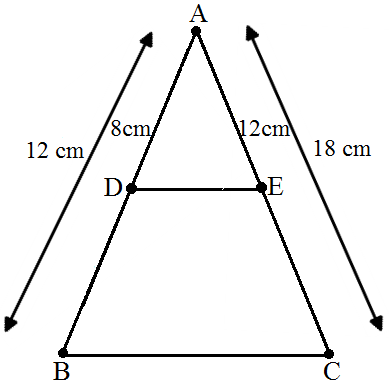
Answer


$\text{AB} = 12\text{cm}, \text{AD} = 12\text{cm}\ \text{and AC} = 18\text{cm.}$
$\therefore\text{AD}=\text{AB}-\text{AD}$
$=12-8$
$\Rightarrow\text{DB}=4\text{cm}$
$\text{And, EC}=\text{AC}-\text{AE}$
$=18-12$
$\Rightarrow\text{EC}=6\text{cm}$
$\text{Now},\frac{\text{AD}}{\text{DB}}=\frac{8}{4}=\frac{2}{1}\ \ [\because\text{DB}=4\text{cm}]$
$\text{And},\frac{\text{AE}}{\text{EC}}=\frac{12}{6}=\frac{2}{1}\ \ [\because\text{EC}=6\text{cm}]$
$\Rightarrow\frac{\text{AD}}{\text{DB}}=\frac{\text{AE}}{\text{EC}}$
Thus, DE divides sides AB and AC of $\triangle\text{ABC}$ in the same ratio.
Therefore, by the converse of basic proportionality theorem.

Need a full question paper?

Generate a complete, print-ready paper with questions like this in minutes — across 16+ boards, with answer keys.
Start Generating Free

Similar questions

Find the non-zero value of k for which the roots of the quadratic equation $9x^2 - 3kx + k = 0$ are real and equal.
Five cards ten, jack, queen, king and an ace of diamonds are shuffled face downwards. One card is picked at random.
  1. What is the probability that the card is a queen?
  2. If a king is drawn first and put aside, what is the probability that the second card picked up is the (i) Ace (ii) King?
A child makes a poster on a chart paper drawing a square ABCD of side 14cm. She draws four circles with centre A, B, C and D in which she suggests different ways to save energy. The circles are drawn in such a way that each circle touches externally two of the three remaining circles (in the following figure). In the shaded region she write a message 'Save Energy'. Find the perimeter and area of the shaded region.$\Big(\text{Use }\pi=\frac{22}{7}\Big)$
Complete the following activity to solve the given word problem. Sum of squares of two consecutive even natural numbers is 244 then find those numbers.
Activity: let the first even natural number be X,
Therefore its consecutive even natural number will be = (.....)
By the given condition,
$X^2+(x+2)^2=244$
$X^2+X^2+4 x+4-(\ldots .)=0$
$2 x^2+4 x-240=0$
$\quad X^2+2 x-120=0$
$X^2+(\ldots \ldots . .)-(\ldots \ldots)-120=0$
$X (x+12) – (…..) (x+12) = 0$
$(x + 12) (x – 10) = 0$
$X = (……) / X = 10$
But natural number cannot be negative $x = -12$ is not possible.
Therefore first even natural number is $x = 10.$
Second even consecutive natural number $= x+ 2= 10+ 2= 12.$
Write the sequence with $n^{th}$​​​​​​​ term:
$a_n = 3 + 4n.$
Show the all of the above sequences form A.P.
A lending library has a fixed charge for the first three days and additional charge for each day thereafter. Saritha paid Rs. 27 for a book kept for seven days, while Susy paid Rs. 21 for the book she kept for five days. Find the fixed charge and the charge for each extra day.
Out of 1900 km, Vishal travelled some distance by bus and some by aeroplane. Bus travels with average speed 60 km/hr and the average speed of aeroplane is 700 km/hr. It takes 5 hours to complete the journey. Find the distance, Vishal travelled by bus.
The area of a sector of a circle of 6 cm radius is 15π sq.cm. Find the measure of the arc and length of the arc corresponding to the sector.
If $\sec2\text{A}=\text{cosec}(\text{A}-42^\circ),$ where 2A is an acute angle, then find the value of A.
If $\text{cosec }\theta=2\text{x and }\cot\theta=\frac{2}{\text{x}},$ find is the value of $2\Big(\text{x}^2-\frac{1}{\text{x}^2}\Big)$.