MCQ
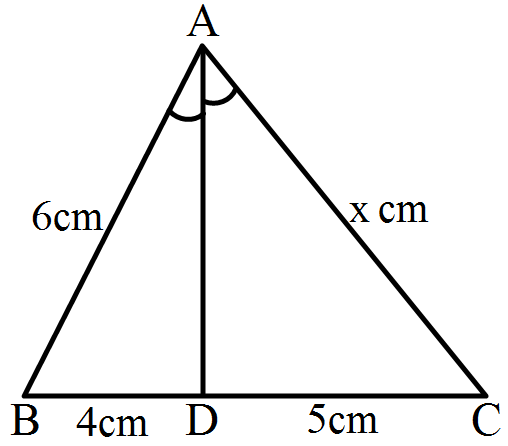
In a $\triangle\text{ABC}$ it is given that $AD$ is the internal bisector of $\angle\text{A}.$ If $BD = 4\ cm, DC = 5\ cm$ and $AB = 6\ cm,$ then $AC =?$​​​​​​​
  • A
    $4.5\ cm$
  • B
    $8\ cm$
  • C
    $9\ cm$
  • $7.5\ cm$

Answer

Correct option: D.
$7.5\ cm$
since $AD$ is the bisector of $\angle\text{A},$
by the angle bisector theorem,
$\frac{\text{AB}}{\text{AC}}=\frac{\text{BD}}{\text{DC}}$
$\Rightarrow\frac{6}{\text{x}}=\frac{4}{5}$
$\Rightarrow\text{x}=7.5\text{cm}$
So, $AC = 7.5\ cm.$

Need a full question paper?

Generate a complete, print-ready paper with questions like this in minutes — across 16+ boards, with answer keys.

Start Generating Free

Similar questions

Altitude on the hypotenuse of a right angled triangle divides it in two parts of lengths 4 cm and 9 cm. Find the length of the altitude.
$\triangle\text{ABC}\sim\triangle\text{DEF}$ and their perimeters are $32\ cm$ and $24\ cm$ respectively. If $AB = 10\ cm$ then $DE =?$
Match the following columns:
 
Column $I$
 
Column $II$
$a.$
The radii of the circular ends of a bucket, in the form of the frustum of a cone of height $30\ cm$, are $20\ cm$ and $10\ cm$ respectively. The capacity of the bucket is $......cm^3$.
$p.$
$2418\pi$
$b.$
The radii of the circular ends of a conical bucket of height $15\ cm$ are $20$ and $12\ cm$ respectively. The slant height of the bucket is $...... cm$.
$q.$
$22000$
$c.$
The radii of the circular ends of a solid frustum of a cone are $33\ cm$ and $27\ cm$ and its slant height is $10\ cm$. The total surface area of the bucket is $....cm^2$.
$r.$
$12$
$d.$
Three solid metallic spheres of radii $3\ cm, 4\ cm$ and $5\ cm$ are melted to form a single solid sphere. The diameter of the resulting sphere is $ ...... cm$.
$s.$
$17$
Three times the square of natural number is 363 is written in the mathematical equation form as ________ .
________ number of tangent/s can be drawn from a point inside the circle.
$(5 + 13 + 21 + .... + 181) = ?$
Out of the following which is a Pythagorean triplet?
Fill in the blanks using correct alternatives. Distance of point $(-3,4)$ from the origin is $...... .$
Mark the correct alternative in the following:
$\text{If }\frac{5+9+13+, ....\text{ to n terms}}{7+9+11+, .....\text{to }(\text{n}+1)\text{ term}}=\frac{17}{16},\text{then n }=$
If $\alpha$ and $\beta$ are the zero of $2x^2 + 5x − 8,$ then the value of $(\alpha\beta)$ is: