Question
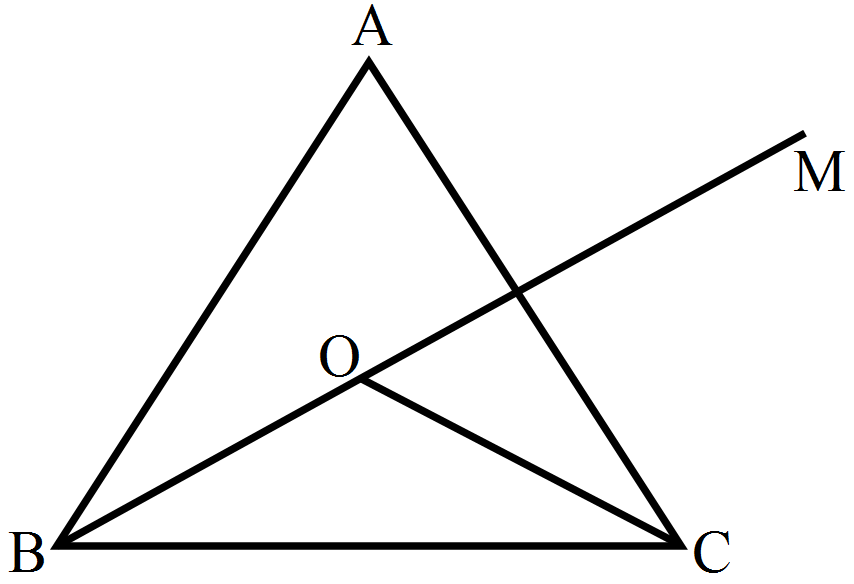
In a $\triangle\text{ABC},$ it is given that $\text{AB}=\text{AC}$ and the bisectors of $B$ and $C$ intersect at $O$. If $M$ is a point on $BO$ produced, prove that $\angle\text{MOC}=\angle\text{ABC}.$
Answer

Given that in $\triangle\text{ABC},$
$\text{AB}=\text{AC}$ and the bisector of $\angle\text{B}$ and $\angle\text{C}$ intersect at $O$.
If $M$ is a point on $BO$ produced

 We have to prove $\angle\text{MOC}=\angle\text{ABC}$
Since, $\text{AB}=\text{AC}$ ABC is isosceles $\angle\text{B}=\angle\text{C}\text{ (or})$
$\angle\text{ABC}=\angle\text{ACB}$
Now, $BO$ and $CO$ are bisectors of $\angle\text{ABC}$ and $\angle\text{ACB}$ respectively $\Rightarrow\text{ABO}=\angle\text{OBC}=\angle\text{ACO}=\angle\text{OCB}$
$=\frac{1}{2}\angle\text{ABC}=\frac{1}{2}\angle\text{ACB}\ ...(\text{i)}$
We have, $\triangle\text{OBC}$
$\angle\text{OBC}+\angle\text{OCB}+\angle\text{BOC}=180^\circ\ ....(\text{ii)}$ And also $\angle\text{BOC}+\angle\text{COM}=180^\circ\ ....(\text{iii)}$ [Straight angle]
Equating $(ii)$ and $(iii)$
$\angle\text{OBC}+\angle\text{OCB}+\angle\text{BOC}=\angle\text{BOC}+\angle\text{MOC}$
$\angle\text{OBC}+\angle\text{OCB}=\angle\text{MOC}$ [From $(i)]$
$2\Big(\frac{1}{2}\angle\text{ABC}\Big)=\angle\text{MOC}$ [From $(i)]$
$\angle\text{ABC}=\angle\text{MOC}$
Therefore, $\angle\text{MOC}-=\angle\text{ABC}$

Need a full question paper?

Generate a complete, print-ready paper with questions like this in minutes — across 16+ boards, with answer keys.

Start Generating Free

Similar questions

The difference between inside and outside surfaces of a cylindrical tube is $14\ cm$ long is $88\ sq$. cm. If the volume of the tube is $176$ cubic $cm$, Find the inner and outer radii of the tube.
The following data gives the production of food grains (In thousand tonnes) for some years:
Year
$1995$
$1996$
$1997$
$1998$
$1999$
$2000$
Production (in thousand tonnes)
$120$
$150$
$140$
$180$
$170$
$190$
Represent the above data with the help of a bar graph.
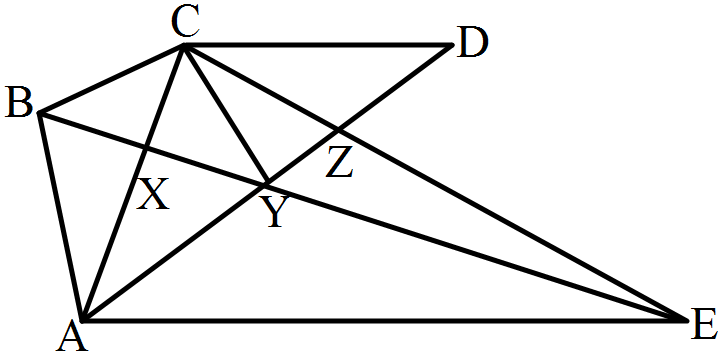
In the given figure, $CD \| AE$ and $CY \| BA$.
$i.$ Name a triangle equal in area of $\triangle\text{CBX}$
$ii.$ Prove that $\text{ar}(\triangle\text{ZDE})=\text{ar}(\triangle\text{CZA})$
$iii.$ Prove that $\text{ar}(\text{BCZY})=\text{ar}(\triangle\text{EDZ}).$
What length of tarpaulin 3m wide will be required to make conical tent of height 8m and base radius 6m? Assume that the extra length of material that will be required for stitching margins and wastage in cutting is approximately 20cm $\big(\text{Use }\pi=3.14\big).$
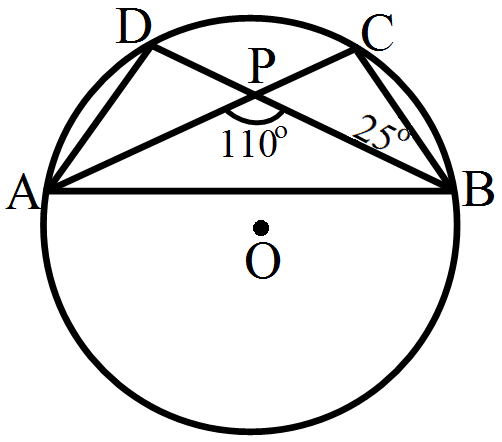
In the given figure, $O$ is the centre of the circle. if $\angle\text{PBC}=25^\circ$ and $\angle\text{APB}=110^\circ,$find the value of $\angle\text{ADB}.$
Represent $\big(1+\sqrt{9.5}\big)$ on the number line.
If a diameter of a circle bisects each of the two chords of a circle then prove that the chords are parallel.
Draw different pairs of circles. How many points does each pair have in common? What is the maximum number of common points?
Using factor theorem, factorize the following polynomials: $x^3 - 6x^2 + 3x + 10$