MCQ
In a vacuum diode, the space around the cathode which is filled with electrons, is called ________:
- ASpace charge
- BElectric field
- CMagnetic field
- DElectron cloud
Explanation:
The large number of free electrons emitted from the cathode is builds up at one place near the cathode and forms a cloud of free electrons. Thus cloud of free electrons near the cathode is called space charge. Due to this space charge, the further emitted electrons come back to the cathode hence no virtual emission takes place hence no current flows in the circuit.
Generate a complete, print-ready paper with questions like this in minutes — across 16+ boards, with answer keys.
Decay constant of radium is λ. By a suitable process its compound radium bromide is obtained. The decay constant of radium bromide will be
|
(a) λ |
(b) More than λ |
(c) Less than λ |
(d) Zero |
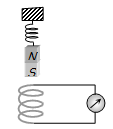
A magnet NS is suspended from a spring and while it oscillates, the magnet moves in and out of the coil C. The coil is connected to a galvanometer G. Then as the magnet oscillates,
|
(a) G shows deflection to the left and right with constant amplitude |
|
(b) G shows deflection on one side |
|
(c) G shows no deflection. |
|
(d) G shows deflection to the left and right but the amplitude steadily decreases. |
Assertion : In Hertz experiment, the electric vector of radiation produced by the source gap is parallel to the gap.
Reason : Production of sparks between the detector gap is maximum when it is placed perpendicular to the source gap.
|
(a) If both assertion and reason are true and the reason is the correct explanation of the assertion. |
|
(b) If both assertion and reason are true but reason is not the correct explanation of the assertion. |
|
(c) If assertion is true but reason is false. |
|
(d) If the assertion and reason both are false. |
Carbon -14 decays with half-life of about 5,800 years. In a sample of bone, the ratio of carbon -14 to carbon -12 is found to be  of what it is in free air. This bone may belong to a period about x centuries ago, where x is nearest to
|
(a) 2 × 58 |
(b) 58 |
(c) 58/2 |
(d) 3 × 58 |
If λ =10Å, then it corresponds to
|
(a) Infra-red |
(b) Microwave |
(c) Ultra-violet |
(d) X-rays |
Two Nicols are oriented with their principal planes making an angle of 60°. The percentage of incident unpolarized light which passes through the system is
|
(a) 50% |
(b) 100% |
(c) 12.5% |
(d) 37.5% |
Two parallel wires are carrying electric currents of equal magnitude and in the same direction. They exert
|
(a) An attractive force on each other |
(b) A repulsive force on each other |
|
(c) No force on each other |
(d) A rotational torque on each other |