MCQ
In a wave, the path difference corresponding to a phase difference of $ \phi$  is
  • A
    $\frac{\pi }{{2\lambda }}\phi$
  • B
    $\frac{\pi }{\lambda }\phi $
  • $\frac{\lambda }{{2\pi }}\phi$
  • D
    $\frac{\lambda }{\pi }\phi$

Answer

Correct option: C.
$\frac{\lambda }{{2\pi }}\phi$
c
(c)For $2$ $\pi$  phase difference $\to$ Path difference is $\lambda$
 For $\phi $ phase difference $\to$ Path difference is $\frac{\lambda }{{2\pi }} \times \phi$

Need a full question paper?

Generate a complete, print-ready paper with questions like this in minutes — across 16+ boards, with answer keys.
Start Generating Free

Similar questions

A person sitting in a chair in a satellite feels weightless because:
Let $K_{1}$ and $K_{2}$ be the maximum kinetic energies of photo-electrons emitted when two monochromatic beams of wavelength $\lambda_{1}$ and $\lambda_{2}$, respectively are incident on a metallic surface. If $\lambda_{1}=3 \lambda_{2}$ then
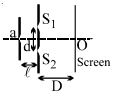
The figure shows a schematic diagram showing the arrangement of Young's Double Slit Experiment If the distance $d$ is varied, then identify the correct statement
Cathode rays enter into a uniform magnetic field perpendicular to the direction of the field. In the magnetic field their path will be
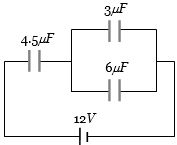
In the circuit shown in the figure, the potential difference across the $4.5\,\mu F$ capacitor is.......$volts$
Two identical glass $(\mu_g = 3/2)$ equiconvex lenses of focal length $f$ each are kept in contact. The space between the two lenses is filled with water $(\mu_w = 4/3).$ The focal length of the combination is
Assertion : Charge is invariant.
Reason : Charge does not depends on speed of frame of reference.
Electron beam used in an electron microscope, when accelerated by a voltage of $20\,kV$. has a de-Broglie wavelength of $\lambda_0$. If the voltage is increased to $40\,kV$. then the de-Broglie wavelength associated with the electron beam would be:
The same radioactive nucleus may emit?
Two small equal point charges of magnitude $q$ are suspended from a common point on the ceiling by insulating mass less strings of equal lengths. They come to equilibrium with each string making angle $\theta $ from the vertical. If the mass of each charge is $m,$ then the electrostatic potential at the centre of line joining them will be $\left( {\frac{1}{{4\pi { \in _0}}} = k} \right).$