In a Wheatstone's bridge, three resistances $P, Q$ and $R$ connected in the three arms and the fourth arm is formed by two resistances $S_1$ and $S_2$ connected in parallel. The condition for the bridge to be balanced will be
AIEEE 2006, Medium


Download our appand get started for free
Experience the future of education. Simply download our apps or reach out to us for more information. Let's shape the future of learning together!No signup needed.*
Similar Questions
- 1A cell of internal resistance $r$ is connected across an external resistance $n r$. Then the ratio of the terminal voltage to the emf of the cell isView Solution
- 2Two batteries with e.m.f $12\ V$ and $13\ V$ are connected in parallel across a load resistor of $10\,\Omega$ . The internal resistances of the two batteries are $1\,\Omega$ and $2\,\Omega$ respectively. The voltage across the load lies betweenView Solution
- 3Two bulbs of $100\, W$ and $200\, W$ working at $220$ $volt$ are joined in series with $220$ $volt$ supply. Total power consumed will be approximately ........... $watt$View Solution
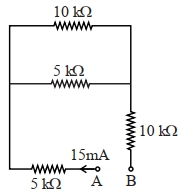
- 4A current of $15\,mA$ flows in the circuit as shown in figure. The value of potential difference between the points $A$ and $B$ will be $...\,V$View Solution
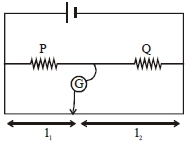
- 5The meter bridge shown is in balanced position with $\frac{\mathrm{P}}{\mathrm{Q}}=\frac{\mathrm{l}_{1}}{\mathrm{l}_{2}}$. If we now litterchange the positions of gavanometer and cell, will the bridge work? If yes, what will be balance condition?View Solution
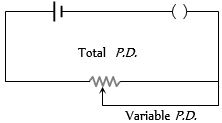
- 6View SolutionThe arrangement as shown in figure is called as
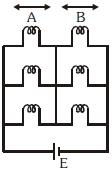
- 7Six similar bulbs are connected as shown in the figure with a $DC$ source of $emf\; E$, and zero internal resistance. The ratio of power consumption by the bulbs when $(i)$ all are glowing and $(ii)$ in the situation when two from section $A$ and one from section $B$ are glowing, will beView Solution
- 8A resistance of $2 \Omega$ is comnected across one gap of a metre-bridge (the length of the wire is $100 \mathrm{~cm}$ ) and an unknown resistance, greater than $2 \Omega$, is connected across the other gap. When these resistance are interchanged, the balance point shifts by $20 \mathrm{~cm}$. Neglecting any corrections, the unknown resistance isView Solution
- 9Match the List $I$ with the List $II$ from the combination shown. In the left side (List $I$) there are four different conditions and in the right side (List $II$), there are ratios of heat produced in each resistance for each condition :View Solution
List $I$ List $II$ $(I)$ Two wires of same resistance are connected in series and same current is passed through them $(A)$ $1:2$ $(II)$ Two wires of resistance $R$ and $2R$ $ohm$ are connected in series and same $P . D .$ is applied across them $(B)$ $4:1$ $(III)$ Two wires of same resistance are connected in parallel and same current is flowing through them $(C)$ $1:1$ $(IV)$ Two wires of resistances in the ratio $1: 2$ are connected in parallel and same $P . D .$ is applied across the $(D)$ $2:1$ - 10For the circuit shown in the figureView Solution
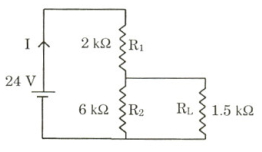
$(A)$ the current $I$ through the battery is $7.5 \mathrm{~mA}$
$(B)$ the potential difference across $R_{\mathrm{L}}$, is $18 \mathrm{~V}$
$(C)$ ratio of powers dissipated in $R_1$ and $R_2$ is $3$
$(D)$ if $R_1$ and $R_2$ are interchanged, magnitude of the power dissipated in $R_{\mathrm{L}}$ will decrease by a factor of $9$