MCQ
In a $YDSE$ apparatus, we use white light then :
  • A
    there will not be a completely dark fringe.
  • B
    the central fringe will be white.
  • C
    the fringe next to the central will be violet
  • All of the above

Answer

Correct option: D.
All of the above
d

Need a full question paper?

Generate a complete, print-ready paper with questions like this in minutes — across 16+ boards, with answer keys.
Start Generating Free

Similar questions

Unpolarized light of intensity $I$ is incident on a system of two polarizers, $A$ followed by $B.$  The intensity of emergent light is $I/2.$  If a third polarizer $C$  is placed between $A$ and $B,$  the intensity of emergent light is reduced to $I/3 .$  The angle between the polarizers $A$ and $C$ is $\theta $ . Then
Which of the following is an example of a molecule whose centre of mass of positive and negative charges does not coincide each other?
Three capacitors whose capacitances are 2,4 and $\chi_\mu F$ respectively. They are combine first in series and then in parallel. In both the cases the ratio of their equivalents will be :
The fringe width in Young’s double slit experiment increases when
An electric bulb is rated $60\,W$, $220\,V$. The resistance of its filament is ............. $\Omega$
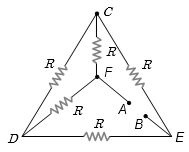
Five equal resistances each of resistance $R$ are connected as shown in the figure. A battery of $V\, volts$ is connected between $A$ and $B$. The current flowing in $AFCEB$ will be
One metre length of wire carries a constant current. The wire is bent to form a circular loop. The magnetic field at the centre of this loop is B. The same is now bent to form a circular loop of smaller radius to have four turns in the loop. The magnetic field at the centre of this new loop is
In the circuit shown in Fig. initially key $K _1$ is closed and key $K _2$ is open. Then $K _1$ is opened and $K _2$ is closed (order is important). [Take $Q _1{ }^{\prime}$ and $Q _2{ }^{\prime}$ as charges on $C _1$ and $C _2$ and $V _1$ and $V _2$ as voltage respectively.] Then
Two point charges $100\,\mu \,C$ and $5\,\mu \,C$ are placed at points $A$ and $B$ respectively with $AB = 40\,cm$. The work done by external force in displacing the charge $5\,\mu \,C$ from $B$ to $C$, where $BC = 30\,cm$, angle $ABC = \frac{\pi }{2}$ and $\frac{1}{{4\pi {\varepsilon _0}}} = 9 \times {10^9}\,N{m^2}/{C^2}$.........$J$
The electric potential (V) inside a uniformly charged. spherical shell depends on distance: