MCQ
In a Young’s double slit experiment, the source illuminating the slits is changed from blue to violet. The width of the fringes
  • A
     Increases
  •  Decreases
  • C
     Becomes unequal
  • D
     Remains constant

Answer

Correct option: B.
 Decreases
 Decreases

Need a full question paper?

Generate a complete, print-ready paper with questions like this in minutes — across 16+ boards, with answer keys.
Start Generating Free

Similar questions

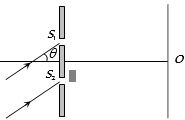
A monochromatic beam of light falls on YDSE apparatus at some angle (say $\theta$) as shown in figure. A thin sheet of glass is inserted in front of the lower slit $S_2$. The central bright fringe (path difference $= 0$) will be obtained
A double convex lens $({R_1} = {R_2} = 10\,cm)$$(\mu = 1.5)$ having focal length equal to the focal length of a concave mirror. The radius of curvature of the concave mirror is.......$cm$
In a Young's double slit experiment with light of wavelength $\lambda ,$ fringe pattern on the screen has fringe width $\beta .$ When two thin transparent glass (refractive index $\mu$ ) plates of thickness $t_1$ and $t_2\,\,(t_1 > t_2)$ are placed in the path of the two beams respectively, the fringe pattern will shift by a distance
An electromagnetic wave of frequency $5\, GHz ,$ is travelling in a medium whose relative electric permittivity and relative magnetic permeability both are $2 .$ Its velocity in this medium is $\times 10^{7}\, m / s$
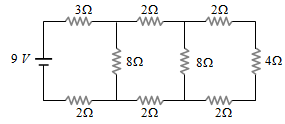
In the circuit shown in the figure, the current through

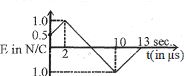
The electric filed through an area of $2\ m^2$ varies with time as shown in the graph. The greatest displacement current through the area is at.....$t=.....sec$
prism can produce a minimum deviation $\delta$ in a light beam. If three such prisms are combined, the minimum deviation that can be produced in this beam is:
If the refractive index of the material of a prism is $\cot \left(\frac{A}{2}\right)$, where $A$ is the angle of prism then the angle of minimum deviation will be
The de Broglie wavelength of an electron moving with kinetic energy of $144 \;eV$ is nearly
Two wave pulses travel in opposite directions on a string and approach each other. The shape of one pulse is inverted with respect to the other.