MCQ
In a Young's double slit experiment the source S and the two slits A and B are vertical with slit A above slit B. The fringes are observed on a vertical screen K. The optical path length from S to B is increased very slightly (by introducing a transparent material of higher refractive index) and the optical path length from S to A is not changed, as a result the fringe system on K moves
  •  Vertically downwards slightly
  • B
     Vertically upwards slightly
  • C
     Horizontally, slightly to the left
  • D
     Horizontally, slightly to the right

Answer

Correct option: A.
 Vertically downwards slightly
Vertically downwards slightly

Need a full question paper?

Generate a complete, print-ready paper with questions like this in minutes — across 16+ boards, with answer keys.

Start Generating Free

Similar questions

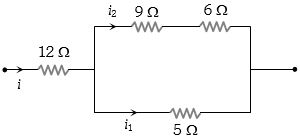
In the following circuit, $5$ $\Omega$ resistor develops $45$ $J/s$ due to current flowing through it. The power developed per second across $12$ $\Omega$ resistor is ............. $W$
At the magnetic North Pole of the Earth, what is the value of the angle of dip?
Microscope is an optical instrument which
With the decrease of current in the primary coil from $2\,amperes$ to zero value in $0.01\,s$ the $emf$ generated in the secondary coil is $1000\,volts$. The mutual inductance of the two coils is......$H$
In which of the following devices, the eddy current effect is not used ?
A particle of charge $q$ and mass $m$ moves in a circular orbit of radius $r$ with angular speed $\omega $. The ratio of the magnitude of its magnetic moment to that of its angular momentum depends on
The black shapes in the figure are closed surfaces. The electric field lines are in red. For which case the net flux through the surfaces is non$-$zero?
Three capacitors whose capacitances are 2,4 and $\chi_\mu F$ respectively. They are combine first in series and then in parallel. In both the cases the ratio of their equivalents will be :
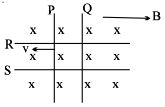
Two identical conductors $P$ and $Q$ are placed on two frictionless rails $R$ and $S$ in a uniform magnetic field directed into the plane. If $P$ is moved in the direction shown in figure with a constant speed then rod $Q$
A particle of mass M and charge Q moving with velocity $\vec{v}$ describes a circular path of radius R when subjected to a uniform transverse magnetic field of induction B. The work done by the field when the particle completes one full circle is