Question
In an AP: $a = 5, d = 3, a_n= 50,$ find $n$ and $S_n$.

Answer

Here, $a = 5, d = 3, a_n= 50$
We know that
$ a_n=a+(n-1) d $
$ \Rightarrow 50=5+(n-1) 3 $
$ \Rightarrow(n-1) 3=50-5 $
$ \Rightarrow(n-1) 3=45 $
$ \Rightarrow n-1=\frac{45}{3} $
$ \Rightarrow n-1=15 $
$ \Rightarrow n=15+1 $
$ \Rightarrow n=16$
$\text { Again, we know that }$
$ S_n=\frac{n}{2}[2 a+(n-1) d] $
$ \Rightarrow S_n=\frac{16}{2}[2(5)+(16-1) 3] $
$ \Rightarrow S_n=8[10+45] $
$ \Rightarrow S_n=8(55) $
$ \Rightarrow S_n=440$

Need a full question paper?

Generate a complete, print-ready paper with questions like this in minutes — across 16+ boards, with answer keys.

Start Generating Free

Similar questions

Solve for x.
$\frac{1}{\text{x}-3}-\frac{1}{\text{x}+5}=\frac{1}{6},$ $\text{x}\neq3,-5$
A train travels $360\ km$ at a uniform speed. If the speed had been $5\ km/hr$ more, it would have taken $1$ hour less for the same journey. Form the quadratic equation to find the speed of the train.
In a $\triangle\text{ABC,D}\ \text{and E}$ are points on the sides $AB$ and $AC$ respectively such that $DE || BC.$
If $\frac{\text{AD}}{\text{DB}}=\frac{3}{4}$ and $AC = 15\ cm,$ find $AE.$
A student noted the number of cars passing through a spot on a road for $100$ periods each of $3$ minutes and summarised it in the table given below. Find the mode of the data.
Number of cars $0-10$ $10-20$ $20-30$ $30-40$ $40-50$ $50-60$ $60-70$ $70--80$
Frequency $7$ $14$ $13$ $12$ $20$ $11$ $15$ $8$
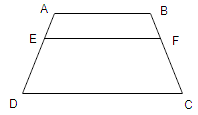
$ABCD$ is a trapezium with $AB || DC. E$ and $F$ are two points on non-parallel sides $AD$ and $BC$ respectively, such that $EF$ is parallel to $AB.$ Show that $\frac{AE}{ED}=\frac{BF}{FC}$ 
Is the following situation possible$?$ If so, determine their present ages. The sum of the ages of two friends is $20$ years ago, the product of their ages in years was $48.$
Find the roots of the following quadratic equation (if they exist) by the method of completing the square.
$x^2-4 a x+4 a^2-b^2=0$
Find the zeros of the following quadratic polynomial and verify the relationship between the zeros and the coefficients:
$2\sqrt3\text{x}^2-\text{5x}+\sqrt3$
If the $10^{th}$ term of an $AP$ is $52$ and $17^{th}$ term is $20$ more than its $13^{th}$ term, find the $AP.$
Find the diameter of the circle whose area is equal to the sum of the areas of two circles having radii $4\ cm$ and $3\ cm.$