Question
In an AP:$ a = 8, a_n= 62, S_n= 210,$ find $n$ and $d$.

Answer

Here, $a = 8$
$a_n= 62$
$S_n= 210$
We know that
$a_n= a + (n - 1)d$
$ \Rightarrow 62 = 8 + (n - 1)d$
$ \Rightarrow 62 - 8 = (n - 1)d$
$ \Rightarrow 54 = (n - 1)d$
$ \Rightarrow (n - 1)d = 54 ........ (1) $
Again we know that
${S_n} = \frac{n}{2}\left[ {2n + (n - 1)d} \right]$
$ \Rightarrow 210 = \frac{n}{2}\left[ {2(8) + (n - 1)d} \right]$
$ \Rightarrow 210 = \frac{n}{2}\left[ {16 + (n - 1)d} \right]$
$ \Rightarrow 210 = \frac{n}{2}\left[ {16 + 54} \right]$$ .........$ Using $(1)$
$ \Rightarrow 210 = \frac{n}{2}(70)$
$ \Rightarrow 210 = 35n$
$ \Rightarrow n = \frac{{210}}{{35}}$
$ \Rightarrow n = 6$
Putting $n = 6$ in equation $(1)$, we get
$(6 - 1)d = 54$
$ \Rightarrow 5d = 54$
$ \Rightarrow d = \frac{{54}}{5}$

Need a full question paper?

Generate a complete, print-ready paper with questions like this in minutes — across 16+ boards, with answer keys.
Start Generating Free

Similar questions

A circular field has a circumference of $36\ km$. Three cyclists start together and can cycle $48, 60$ and $72\ km$ a day, round the field. When will they meet again$?$
A hemispherical depression is cut out from one face of a cubical wooden block of edge $21\ cm$, such that the diameter of the hemisphere is equal to the edge of the cube. Determine the volume and total surface area of the remaining block.
If $\alpha$ and $\beta$ are the zeroes of the quadratic polynomial $f(x) = ax^2+ bx + c,$ find evaluate: $\text{a}\Big(\frac{\alpha^2}{\beta}+\frac{\beta^2}{\alpha}\Big)+\text{b}\Big(\frac{\alpha}{\beta}+\frac{\beta}{\alpha}\Big)$
Prove the given identity, where the angles involved are acute angles for which the expressions are defined.$ \frac{{\tan A }}{{1 - \cot A }} + \frac{{\cot A }}{{1 - \tan A }} = 1 + sec A \cos ecA$
[Hint: Write the expression in terms of $\sin \theta$ and$ \cos \theta$]
Sides AB and AC and median AD of a triangle ABC are respectively proportional to sides PQ and PR and median PM of another triangle PQR. Show that $\Delta A B C \sim \Delta P Q R$.
Given $\tan A = \frac{4}{3}$, find all other trigonometric ratios of the angle $A.$
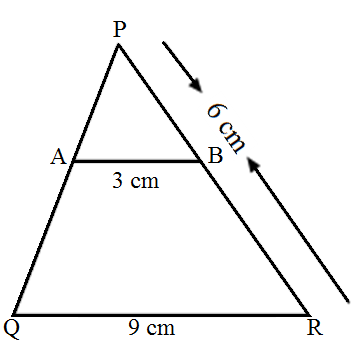
In the given figure, $AB || QR.$ Find the length of $PB$.
Solve the following quadratic equations by factorization:
$2 x^2+a x-a^2=0$
A ladder is placed along a wall of a house such that its upper end is touching the top of the wall. The foot of the ladder is 2m away from the wall and the ladder is making an angle of $60^\circ $ with the level of the ground. Determine the height of the wall.
Find the zeroes of quadratic polynomial $x^2- 2x - 8$ and verify the relationship between the zeroes and their coefficients.