Question
In an $A P$, if $S_n=n(4 n+1)$, find the $A P$.

Answer

We know that, the $n^{\text {th }}$ term of an AP is
$a_n = S_n - S_{n-1}$[$\because$ $S_n = n(4n + 1)]$
$a_n = n(4n + 1) - (n - 1){4(n - 1) + 1}$
$a_n = 4n^2 + n - (n - 1)(4n - 3)$
$a_n = 4n^2 + n - 4n^2 + 3n + 4n - 3$
$a_n = 8n - 3$
Put n $= 1, a_1 = 8(1) - 3 = 5$
Put n $= 2, a_2 = 8(2) - 3 = 16 - 3 = 13$
Put n$ = 3, a_3 = 8(3) - 3 = 24 - 3 = 21$
Hence, the required $AP$ is $5, 13, 21, ......$

Need a full question paper?

Generate a complete, print-ready paper with questions like this in minutes — across 16+ boards, with answer keys.
Start Generating Free

Similar questions

A thief, after committing a theft runs at a uniform speed of $50m$/ minute. After $2$ minutes, a policeman runs to catch him. He goes $60$ min first minute and increases his speed by $5m$/ minute every succeeding minute. After how many minutes, the policeman will catch the thief?
If the point $P(m, 3)$ lies on the line segment joining the points $A\left(-\frac{2}{5}, 6\right)$ and $B(2,8)$, find the value of $m$.
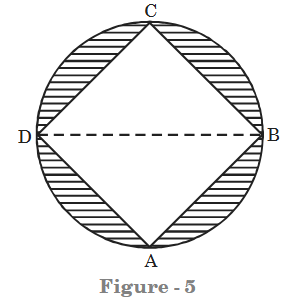
In Figure-5, ABCD is a square with side 7 cm . A circle is drawn circumscribing the square. Find the area of the shaded region.
Image
Write the exponent of $2$ in the price factorization of $144.$
Divide 56 in four parts in A.P. such that the ratio of the product of their extremes to the product of their means is 5 : 6.
Determine the set of values of k for which the given following quadratic has real root:
$2 x^2+k x-4=0$
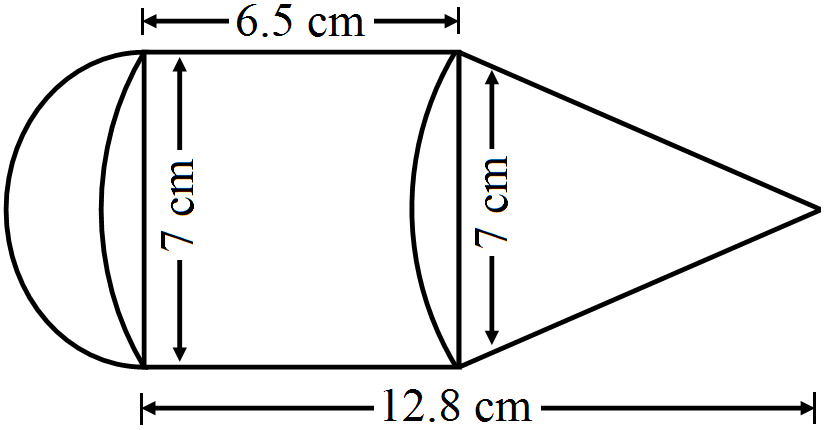
The given figure represents a solid consisting of a cylinder surmounted by a cone at one end and a hemisphere at the other. Find the volurne of the solid.
The age of the father is twice the sum of the ages of his two children. After 20 years, his age will be equal to the sum of the ages of his children. Find the age of the father.
In two concentric circles, a chord of length $8 \ cm$ of the larger circle touches the smaller circle. If the radius of the larger circle is $5 \ cm$ then find the radius of the smaller circle.
Find the value of a and b for which the following systems of linear equations has an infinite number of solutions:
$2x - 3y = 7,$
$(a + b)x - (a + b - 3)y = 4a + b$