MCQ
In an Arithmetic Progression 2,4,6,8,……..the common difference d is………..
  • A
    8
  • B
    6
  • 2
  • D
    -2

Answer

Correct option: C.
2
2

Need a full question paper?

Generate a complete, print-ready paper with questions like this in minutes — across 16+ boards, with answer keys.
Start Generating Free

Similar questions

If the area of the triangle formed by the points $(x, 2x), (-2, 6)$ and $(3, 1)$ is $5$ square units, then $x =$
Four alternative answers for each of the following questions are given. Choose the correct alternative.
A circle touches all sides of a parallelogram. So the parallelogram must be a,................... .
A. rectangle
B. rhombus
C. square
D. trapezium
Two circles intersect each other such that each circle passes through the centre of the other. If the distance between their centres is 12, what is the radius of each circle?
Image
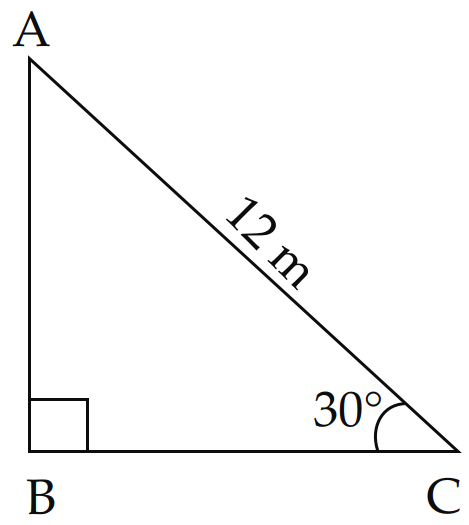
In the adjoining figure, if $\angle B=90^{\circ}, \angle C=30^{\circ}$, $A C=12 m$. then $A B=$ _______
If $8\tan \text{x} = 15,$ then $\sin \text{x} - \cos \text{x}$ is equal to:
The material of a cone is converted into the shape of a cylinder of equal radius. If height of the cylinder is $5\ cm,$ then height of the cone is:
If the sum of the areas of two circles with radii $R1$ and $R2$ is equal to the area of a circle of radius $R$, then:
Assertion and Reason Type
Each question consists of two statements, namely, Assertion $(A)$ and Reason $(R).$ For selecting the correct answer, use the following code:
Assertion $(A)$
Reason $(R)$
If the volumes of two spheres are in the ratio $27 : 8$ then their surface areas are in the ratio $3: 2.$
Volume of a sphere $=\frac{4}{3}\pi\text{R}^3.$
Surface area of a sphere $=4\pi\text{R}^2.$
The median of a frequency distribution is found graphically with the help of:
Select the appropriate alternative.
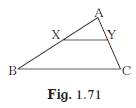
In figure 1.71, seg XY || seg BC, then which of the following statements is true?

$A.\frac{A B}{A C}=\frac{A X}{A Y}$
$B.\frac{A X}{X B}=\frac{A Y}{A C}$
$C.\frac{A X}{Y C}=\frac{A Y}{X B}$
$D.\frac{A B}{Y C}=\frac{A C}{X B}$