MCQ
In an elevator moving vertically up with an acceleration $'g\ ',$ the force exerted on the floor by a passenger of mass $M$ is:
  • A
    $Mg$
  • B
    $\frac{1}{2}\text{Mg}$
  • C
    zero
  • $2Mg$

Answer

Correct option: D.
$2Mg$
Force exerted by the passenger on floor
$= R = M(g + a)$
$= M(g + g)$
$= 2Mg$

Need a full question paper?

Generate a complete, print-ready paper with questions like this in minutes — across 16+ boards, with answer keys.
Start Generating Free

Similar questions

An object is at a temperature of ${400^o}C$. At what temperature would it radiate energy twice as fast? The temperature of the surroundings may be assumed to be negligible
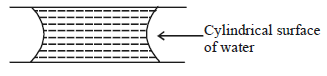
If two glass plates have water between them and are separated by very small distance (see figure), it is very difficult to pull them apart. It is because the water in between forms cylindrical surface on the side that gives rise to lower pressure in the water in comparison to atmosphere. If the radius of the cylindrical surface is $R$ and surface tension of water is $T$ then the pressure in water between the plates is lower by
A bomb of mass $1\ kg$ is thrown vertically upwards with a speed of $100\ m/s.$ After $5$ seconds, it explodes into two fragments. One fragment of mass $400\ gm$ is found to go down with a speed of $25\ m/s.$ What will happen to second fragment just after explosion? $(g = 10\ m/s^2).$
A ball is thrown at different angles with the same speed $u$ and from the same point. It has the same range in both cases. If $y_1$ and $y_2$ be the heights attained in the two cases, then $y_1+y_2$ equals to
Energy required to move a body of mass $m$ from an orbit of radius $2R$ to $3R$ is
A beaker containing a liquid is kept inside a big closed jar. If the air inside the jar is continuously pumped out, the pressure in the liquid near the bottom of the liquid will
A composite rod made up of two rods $AB$ and $BC$ are joined at $B$ . The rods are of equal length at room temperature and have equal masses. The coefficient of linear expansion a of $AB$ is more than that of $BC$. The composite rod is suspended horizontal by means of a thread at $B$. When the rod is heated
A steel ball is dropped in oil, then
A cylinder of mass $1\,kg$ is given heat of $20000\, J$ at atmospheric pressure. If initially temperature of cylinder is $20\,^oC$, then work done by the cylinder will be .......$J$ (Given that Specific heat of cylinder $= 400 \,J\, kg^{-1}$, Coefficient of volume expansion $= 9 \times {10^{-5}}\,^o C^{-1}$, Atmospheric pressure $= 10^5 \,N/m^2$ and density of cylinder $9000\,kg/m^3$)
A motor cyclist going round in a circular track at constant speed has