MCQ
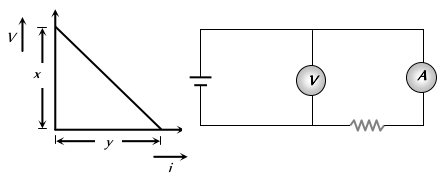
In an experiment, a graph "was plotted of the potential difference $V$ between the terminals of a cell against the circuit current $i$ by varying load rheostat. Internal conductance of the cell is given by
Image

  • A
    $x y$
  • $\frac{y}{x}$
  • C
    $\frac{x}{y}$
  • D
    $(\mathrm{d})(x-y)$

Answer

Correct option: B.
$\frac{y}{x}$
(b) Here internal resistance is given by the slope of graph i.e. $\frac{x}{y}$. But conductance $=\frac{1}{\text { Resistance }}=\frac{y}{x}$

Need a full question paper?

Generate a complete, print-ready paper with questions like this in minutes — across 16+ boards, with answer keys.

Start Generating Free

Similar questions

If $R$ is the Rydberg's constant for hydrogen the wave number of the first line in the lyman series will be
A racing car moving towards a cliff, sounds its horn. The driver observes that the sound reflected from the cliff has a pitch one octave higher than the actual sound of the horn. If $v$ is the velocity of sound, then the velocity of the car is
A projectile thrown with a speed $v$ at an angle $\theta$ has a range $R$ on the surface of earth. For same $v$ and $\theta$, its range on the surface of moon will be
Two bodies $A$ and $B$ having masses in the ratio of $3: 1$ possess the same kinetic energy. The ratio of their linear momenta is then
The unit for nuclear dose given to a patient is
Two perfectly elastic particles $P$ and $Q$ of equal mass travelling along the line joining them with velocities $15 \mathrm{~m} / \mathrm{sec}$ and $10 \mathrm{~m} / \mathrm{sec}$. After collision, their velocities respectively (in $\mathrm{m} / \mathrm{sec}$ ) will be
Current in the circuit is wattless, if
X-rays are
A moving coil galvanometer has $150$ equal divisions. Its current sensitivity is $10$ divisions per milliampere and voltage sensitivity is $2$ divisions per millivolt. In order that each division reads $1$ volt, the resistance in ohms needed to be connected in series with the coil will be
A constant voltage is applied between the two ends of a metallic wire. If both the length and the radius of the wire are doubled, the rate of heat developed in the wire