Question
In an experiment, it was found that a tuning fork and a sonometer wire gave 5 beats per second, both when the length of the wire was 1m, and 1.05m. Calculate the frequency of the fork.

Answer

We know $\text{v}=\frac{1}{2\text{l}}\sqrt{\frac{\text{T}}{\mu}}$
I case: $\text{v}_1=\frac{1}{2\times1}\sqrt{\frac{\text{T}}{\mu}}\ ... (\text{i})$
II case: $\text{v}_2=\frac{1}{2\times1.05}\sqrt{\frac{\text{T}}{\mu}}\ ...\text{(ii)}$
Let v be the frequecy of the tuning fork, therefore,
$\text{v}_1-\text{v}=5$ and $\text{v}-\text{v}_2=5$
$\text{v}_1=\text{v}+5$
and $\text{v}_2=\text{v}-5$
$\frac{\text{v}_1}{\text{v}_2}=\frac{5+\text{v}}{\text{v}-5}$
From (i) and (ii), we have
$\frac{\text{v}+5}{\text{v}-5}=\frac{1}{2}\times2\times1.05=1.05$
$\frac{\text{v}+5}{\text{v}-5}=\frac{105}{100}=\frac{21}{20}$
$\Rightarrow\text{v}=205\text{Hz}$

Need a full question paper?

Generate a complete, print-ready paper with questions like this in minutes — across 16+ boards, with answer keys.
Start Generating Free

Similar questions

When ice melts, then change in internal energy is greater than the heat supplied, why?
Give the salient features of Einstein's theory.
What is meant by triple point? Give the values of triple point pressure and triple point temperature of water.
The transverse displacement of a string (clamped at its both ends) is given by
$\text{y}(\text{x, t})=0.06\sin\Big(\frac{2\pi}{3}\text{x}\Big)\cos(120\pi\text{ t})$
where x and y are in m and t in s. The length of the string is 1.5m and its mass is $3.0 \times 10^{–2}kg$.
Answer the following:
Does the function represent a travelling wave or a stationary wave?
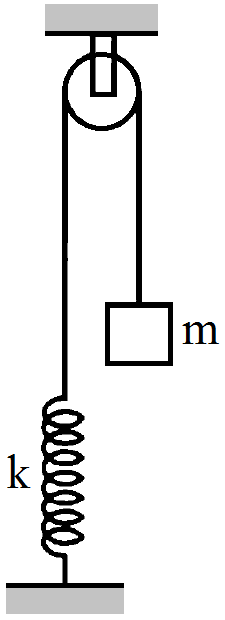
Consider the situation shown in figure. Initially the spring is unstretched when the system is released from rest. Assuming no friction in the pulley, find the maximum elongation of the spring.
In simple harmonic motion, the period of oscillation is 0.5 seconds and the amplitude is 0.1 m. Find the maximum velocity and maximum acceleration of the oscillator.
$30^{\circ}$ temperature find the root mean square velocity of nitrogen molecules at 76 cm (Mercury) Pressure.
A body rotates about a fixed axis with an angular acceleration of one radian/ second/ second. Through what angle does it rotate during the time in which its angular velocity increases from 5rad/s to 15rad/s.
Just as precise measurements are necessary in science, it is equally important to be able to make rough estimates of quantities using rudimentary ideas and common observations. Think of ways by which you can estimate the following (where an estimate is difficult to obtain, try to get an upper bound on the quantity): The number of strands of hair on your head.
A clock controlled by an oscillator becomes slow when taken from a field to a mountain. But the wrist watch controlled by the spring remains unaffected. Explain the reason for this difference in the behaviour of clocks.