MCQ
In an experiment on simple pendulum to determine the acceleration due to gravity, a student measures the length of the thread as $63.2 \,cm$ and diameter of the pendulum bob as $2.256 \,cm$. The student should take the length of the pendulum to be ........... $cm$
  • A
    $64.328$
  • $64.3$
  • C
    $65.456$
  • D
    $65.5$

Answer

Correct option: B.
$64.3$
b
(b)

Length of pendulum = Length of thread + Radius of bob

$=63.2+\frac{2.256}{2}=63.2+1128$

$=64.328 \,cm$

But now the student must apply rule for taking significant digits in a measurement.

In addition or subtraction,

Number of digits after decimal in result

= Least number of digits after decimal in quantities added

So, length of pendulum $=64.3 \,cm$.

Need a full question paper?

Generate a complete, print-ready paper with questions like this in minutes — across 16+ boards, with answer keys.

Start Generating Free

Similar questions

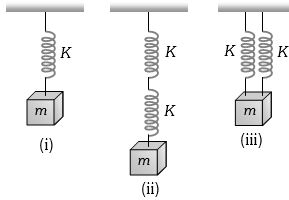
Five identical springs are used in the following three configurations. The time periods of vertical oscillations in configurations (i), (ii) and (iii) are in the ratio
The internal energy of an ideal gas decreases by the same amount as the work done by the system:
  1. The process must be adiabatic.
  2. The process must be isothermal.
  3. The process must be isobaric.
  4. The temperature must decrease.
There is rod of length $l$. The velocities of its two ends are $v_1$ and $v_2$ in opposite directions normal to the rod. The distance of the instantaneous axis of rotation from $v_1$ is:
Moment of momentum is called:
As the temperature is increased, the time period of a pendulum:
A solid sphere of radius $R$ and density $\rho$ is attached to one end of a mass-less spring of force constant $k$. The other end of the spring is connected to another solid sphere of radius $R$ and density $3 p$. The complete arrangement is placed in a liquid of density $2 p$ and is allowed to reach equilibrium. The correct statement$(s)$ is (are)

$(A)$ the net elongation of the spring is $\frac{4 \pi R^3 \rho g}{3 k}$

$(B)$ the net elongation of the spring is $\frac{8 \pi R^3 \rho g}{3 k}$

$(C)$ the light sphere is partially submerged.

$(D)$ the light sphere is completely submerged.

Sand is being dropped on a conveyer belt at the rate of $M\, kg/s.$ The force necessary to keep the belt moving with a constant velocity of $v\,m/s$ will be
If two waves having amplitudes $2A$ and $A$ and same frequency and velocity, propagate in the same direction in the same phase, the resulting amplitude will be
The moment of inertia of a solid sphere of density $\rho $ and radius R about its diameter is
Using dimensional analysis, the resistivity in terms of fundamental constants $h, m_{e}, c, e, \varepsilon_{0}$ can be expressed as