MCQ
In an interference experiment, the spacing between successive maxima or minima is (Where the symbols have their usual meanings)
  • A
    $\frac{\lambda d}{D}$
  • $\frac{\lambda D}{d}$
  • C
    $\frac{dD}{\lambda}$
  • D
    $\frac{\lambda d}{4D}$

Answer

Correct option: B.
$\frac{\lambda D}{d}$
(b) $\frac{\lambda D}{d}$

Need a full question paper?

Generate a complete, print-ready paper with questions like this in minutes — across 16+ boards, with answer keys.
Start Generating Free

Similar questions

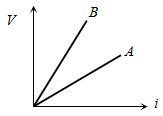
V-i graphs for parallel and series combination of two identical resistors are as shown in figure. Which graph represents parallel combination

Find $x$ in the following nuclear reaction. ${ }_2 \mathrm{He}^4+{ }_{13} \mathrm{Al}^{27} \rightarrow{ }_x \mathrm{P}^{30}+{ }_0 \mathrm{n}^1$
A parallel plate condenser with oil between the plates (dielectric constant of oil $K = 2$) has a capacitance $C$. If the oil is removed, then capacitance of the capacitor becomes
The continuous part of $X$-ray spectrum is a result of the
$A$ constant voltage is applied between the two ends of a uniform metallic wire. Some heat is developed in it. The heat developed is doubled if
What is the angle of dip at the magnetic poles?
If the distance between the plates of parallel plate capacitor is halved and the dielectric constant of dielectric is doubled, then its capacity will
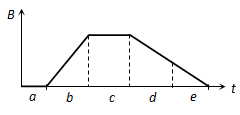
The graph gives the magnitude B(t) of a uniform magnetic field that exists throughout a conducting loop, perpendicular to the plane of the loop. Rank the five regions of the graph according to the magnitude of the emf induced in the loop, greatest first
If $2.5 \times 10^{-6\,} N$ average force is exerted by a light wave on a non-reflecting surface of $30\, cm ^{2}$ area during $40$ minutes of time span, the energy flux of light just before it falls on the surface is .................. $W / cm ^{2}$

(Round off to the Nearest Integer)

(Assume complete absorption and normal incidence conditions are there)

A convex lens is made up of three different materials as shown in the figure. For a point object placed on its axis, the number of images formed are