MCQ
In an intrinsic semiconductor, conductivity is:
- ALow at room temperature
- BAverage
- CHigh at room temperature
- DZero at room temperature
Explanation:
In intrinsic semiconductors, n = p. Hence, at room temperature, no free electrons are available for conduction. If the temperature is increased, the covalent bonds will break and electrons will be freed, each electron will leave behind a hole and capture a new hole the process will continued and charge flows through intrinsic semiconductor.
Thus, its conductivity increases with temperature. Hence, in intrinsic semiconductor conductivity is low at room temperature.
Generate a complete, print-ready paper with questions like this in minutes — across 16+ boards, with answer keys.
The spectrum of light emitted by a glowing solid is
|
(a) Continuous spectrum |
(b) Line spectrum |
(c) Band spectrum |
(d) Absorption spectrum |
An α -particle is accelerated through a potential difference of 200V. The increase in its kinetic energy is
|
(a) 100 eV |
(b) 200 eV |
(c) 400 eV |
(d) 800 eV |
In P-N junction, avalanche current flows in circuit when biasing is
| (a) Forward | (b) Reverse | (c) Zero | (d) Excess |
The example of nuclear fusion is
|
(a) Formation of barium and krypton from uranium |
|
(b) Formation of helium from hydrogen |
|
(c) Formation of plutonium 235 from uranium 235 |
|
(d) Formation of water from hydrogen and oxygen |
In Bohr model of the hydrogen atom, the lowest orbit corresponds to
|
(a) Infinite energy |
(b) The maximum energy |
|
(c) The minimum energy |
(d) Zero energy |
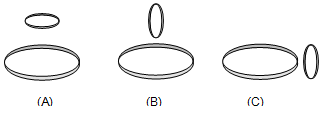
Two circular coils can be arranged in any of the three situations shown in the figure. Their mutual inductance will be
|
(a) Maximum in situation (A) |
(b) Maximum in situation (B) |
|
(c) Maximum in situation (C) |
(d) The same in all situations |
A radioactive substance has an average life of 5 hours. In a time of 5 hours
|
(a) Half of the active nuclei decay |
(b) Less than half of the active nuclei decay |
|
(c) More than half of the active nuclei decay |
(d) All active nuclei decay |
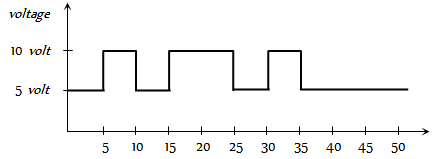
In a negative logic the following wave form corresponds to the
|
(a) 0000000000 |
(b) 0101101000 |
(c) 1111111111 |
(d) 1010010111 |