MCQ
In an isothermal change, an ideal gas obeys
  • Boyle's law
  • B
    Charle's law
  • C
    Gaylussac law
  • D
    None of the above

Answer

Correct option: A.
Boyle's law
(a) In isothermal process, compressibility $E_\theta=\rho$.

Need a full question paper?

Generate a complete, print-ready paper with questions like this in minutes — across 16+ boards, with answer keys.

Start Generating Free

Similar questions

An open knife edge of mass ' $m$ ' is dropped from a height ' $h$ ' on a wooden floor. If the blade penetrates upto the depth ' $\mathrm{d}$ ' into the wood, the average resistance offered by the wood to the knife edge is
The quantity that is not conserved in an inelastic collision is
Two waves of frequencies $20 \mathrm{~Hz}$ and $30 \mathrm{~Hz}$. Travels out from a common point. The phase difference between them after $0.6 \mathrm{sec}$ is
Which of the following statement is wrong
A transformer with efficiency $80 \%$ works at $4\  k W$ and $100 \mathrm{~V}$. If the secondary voltage is $200 \mathrm{~V}$, then the primary and secondary currents are respectively
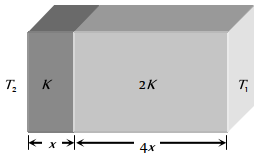
The temperature of the two outer surfaces of a composite slab, consisting of two materials having coefficients of thermal conductivity $K$ and $2 K$ and thickness $x$ and $4 x$, respectively are $T$ and $T(T>T)$. The rate of heat transfer through the slab, in a steady state is $\left(\frac{A\left(T_2-T_1\right) K}{x}\right) f$, with $f$ which equal to
Image
A rod of a certain metal is $1.0 \mathrm{~m}$ long and $0.6 \mathrm{~cm}$ in diameter. lts resistance is $3.0 \times 10^{-3} \mathrm{ohm}$. Another disc made of the same metal is $2.0 \mathrm{~cm}$ in diameter and $1.0 \mathrm{~mm}$ thick. What is the resistance between the round faces of the disc
The function $\sin ^2(\omega t)$ represents
The time period of oscillation of a bar magnet suspended horizontally along the magnetic meridian is $T$. If this magnet is replaced by another magnet of the same size and pole strength but with double the mass, the new time period will be
The apparent weight of the body, when it is travelling upwards with an acceleration of $2\  m / s ^2$ and mass is $10\  kg$, will be