MCQ
In an isothermal expansion
  • A
    Internal energy of the gas increases
  • B
    Internal energy of the gas decreases
  • Internal energy remains unchanged
  • D
    Average kinetic energy of gas molecule decreases

Answer

Correct option: C.
Internal energy remains unchanged
c
(c) In isothermal expansion temperature remains constant, hence no change in internal energy.

Need a full question paper?

Generate a complete, print-ready paper with questions like this in minutes — across 16+ boards, with answer keys.
Start Generating Free

Similar questions

A very thin metallic shell of radius $r$ is heated to temperature $T$ and then allowed to cool. The rate of cooling of shell is proportional to ........
A man is running at a speed of $5\, m/s$, the rain drops appear to be falling at an angle of $45^o$ from the vertical. If the rain drops are actually falling vertically downwards, then velocity of rain drops (in $m/s$) is
A force of $16N$ is distributed uniformly on one surface of a cube of edge $8\ cm.$ The pressure on this surface is:
Two spheres of same size one of mass $2\, kg$ and another of mass $4\, kg$ are dropped simultaneously from the top of Qutab Minar(height $= 72\,m$). When they are $1\,m$ above the ground, the two spheres have the same
A cubical solid aluminium (bulk modulus $=-V \frac{ dP }{ dV }=70 GPa$ ) block has an edge length of $1 m$ on the surface of the earth. It is kept on the floor of a $5 km$ deep ocean. Taking the average density of water and the acceleration due to gravity to be $10^3 kg m ^{-3}$ and $10 ms ^{-2}$, respectively, the change in the edge length of the block in $mm$ is . . . . .
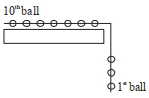
A system to $10$ balls each of mass $2 \; kg$ are connected via massless and unstretchable string. The system is allowed to slip over the edge of a smooth table as shown in figure. Tension on the string between the $7^{th}$ and $8^{th}$ ball is $N$ when $6^{th}$ ball just leaves the table.
The velocity of the molecules of a gas at temperature $120\,K$ is $v$. At ...... $K$ temperature will the velocity be $2v$
If there were no gravity. which of the following will not be there for a fluid?
It is estimated that per minute each $cm^2$ of earth receives about $2\ cal (1\ cal = 4.18\ J)$ of heat  energy from the sun. This is called Solar constant. In $SI$ units the value is
Two pieces of glass plate one upon the other with a little water in between them cannot be separated easily because of