MCQ
In an LED device, the intensity of emitted light:
  • A
    Increases continuously with the forward current of the diode.
  • B
    Increases continuously with the forward current of the diode, reaches a maximum and then decreases.
  • C
    Decreases continuously with the forward current of the diode.
  • D
    Decreases continuously with the forward current of the diode, reaches a minimum and then increases.

Answer

  1. Increases continuously with the forward current of the diode, reaches a maximum and then decreases.

Explanation:

The intensity of emitted light increase with the foreword current more the light intensity.

Need a full question paper?

Generate a complete, print-ready paper with questions like this in minutes — across 16+ boards, with answer keys.

Start Generating Free

Similar questions

Consider aiming a beam of free electrons towards free protons. When they scatter, an electron and a proton cannot combine to produce a H-atom:

When radiation is incident on a photoelectron emitter, the stopping potential is found to be 9 volts. If e/m for the electron is  1.8   the maximum velocity of the ejected electrons is

(a) 6   

(b) 8  

(c) 1.8  

(d) 1.8  

3.8 days is the half-life period of a sample. After how many days, the sample will become 1/8th of the original substance

(a) 11.4

(b) 3.8

(c) 3  

(d) None of these

PQRS is a square loop made of uniform conducting wire the current enters the loop at P and leaves at S.  Then the magnetic field will be

(a) Maximum at the centre of the loop

(b) Zero at the centre of loop

(c) Zero at all points inside the loop

(d) Zero at all points outside of the loop

Dispersion can take place for

(a) Transverse waves only but not for longitudinal waves

(b) Longitudinal waves only but not for transverse waves

(c) Both transverse and longitudinal waves

(d) Neither transverse nor longitudinal waves

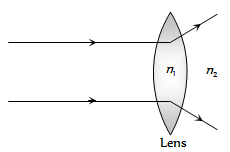
The relation between n1 and n2, if behaviour of light rays is as shown in figure is

(a)   

(b)  

(c)  

(d)  

A parallel plate capacitor is first charged and then a dielectric slab is introduced between the plates. The quantity that remains unchanged is

(a) Charge Q

(b) Potential V

(c) Capacity C

(d) Energy U

A body is rotating nonuniformity about a vertical axis fixed in an inertial frame. The resultant force on a particle of the body not on the axis is:
  1. Vertical.
  2. Horizontal and skew with the axis.
  3. Horizontal and intersecting the axis.
  4. None of these.

The wrong statement about electric lines of force is

(a) These originate from positive charge and end on negative charge

(b) They do not intersect each other at a point

(c) They have the same form for a point charge and a sphere

(d) They have physical existence

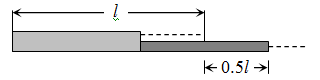
In order to quadruple the resistance of a uniform wire, a part of its length was uniformly stretched till the final length of the entire wire was 1.5 times the original length, the part of the wire was fraction equal to

(a) 1 / 8

(b) 1 / 6

(c) 1 / 10 

(d) 1 / 4